Do Sharks Sleep? What Science Actually Knows
Yes — sharks do sleep, but not the way you do. Some species settle motionless on the seabed for hours, while others keep swimming the entire time, entering a restful state without ever stopping. Because sharks lack eyelids that close and brains that produce the sleep signals scientists measure in humans, researchers judge shark sleep by behaviour and metabolism instead. This guide walks through what the evidence actually shows: how sharks breathe while resting, where they do it, whether their eyes stay open, and why great whites and whale sharks are a special case.
What “Sleep” Actually Means for a Fish
Before asking whether sharks sleep, it helps to know what biologists mean by the word. Sleep is not simply “lying still.” Scientists generally look for four signs: a reduction in responsiveness to the outside world, a typical posture or resting site, rapid reversibility — you can wake the animal, unlike a coma — and evidence that the animal makes up for lost sleep afterwards.
In humans, birds and other mammals, there is a shortcut: brain waves. An EEG shows distinct electrical patterns during sleep, and those patterns are the gold standard for saying an animal is asleep rather than merely resting.
Sharks do not offer that shortcut. Their brains are organised very differently from ours and do not generate the same electrical signatures, so an EEG cannot answer the question the way it does for a sleeping dog. Researchers studying shark sleep therefore rely on behavioural and physiological markers: how quickly a shark reacts to a stimulus, what posture it holds, and — most usefully — how much oxygen it consumes.
That last measure matters, because metabolic rate is hard to fake. An animal that is genuinely resting burns measurably less energy than one that is simply idling.
Do All Fish Sleep?
Sharks are not an exception among fish. Sleep-like states appear across the fish world, which makes the case for shark sleep considerably more plausible than it once seemed.
The best-studied example is the zebrafish, a small freshwater species that has become a standard laboratory model for sleep research. Zebrafish show periods of reduced activity and raised arousal threshold, they settle into characteristic postures, and — importantly — they compensate afterwards if the rest is interrupted. That last point is the clincher for biologists: an animal that makes up for lost rest is regulating something, not merely idle.
Coral reefs offer the most visible version. Swim over a reef at night and you will find fish that were darting through the water at midday now wedged into crevices, hovering motionless in the open, or tucked under coral heads. Some species change colour after dark. Parrotfish go further, secreting a mucus envelope around themselves before settling for the night — a barrier thought to mask their scent from predators and parasites.
None of this looks like human sleep, and none of it produces human brain waves. But it fits the behavioural definition well enough that the question for sharks stopped being “do fish sleep at all?” and became “how do sharks in particular manage it?”
That reframing matters. If sleep is ancient and widespread among vertebrates — and the evidence increasingly says it is — then the burden of proof shifts. The surprising claim would be that sharks, alone among fish, do not sleep.
Do Sharks Sleep?
The evidence says yes, at least for the species that have been studied closely.
The strongest case comes from a 2022 study on the draughtsboard shark (Cephaloscyllium isabellum), a small bottom-dwelling species from New Zealand, published in the Royal Society journal Biology Letters. Researchers treated inactivity lasting more than five minutes as sleep, and found that oxygen consumption fell significantly during those periods — the signature of a genuine resting state rather than a pause between activities. The sharks also adopted a characteristic flat posture against the seabed while in this state.
That study matters because it moved the conversation past anecdote. Divers had described motionless sharks for decades, but “motionless” and “asleep” are not the same thing. Measuring the metabolic drop provided physical evidence that something like sleep was occurring.
What the evidence does not support is the idea that every shark sleeps in the same way. The 500-plus shark species differ enormously in how they live, and — crucially — in how they breathe. That single difference splits the answer in two.
In plain terms, the answer to “can sharks sleep?” is yes — the metabolic evidence settles it for the species studied so far.
How Scientists Study Shark Sleep
Understanding how the evidence is gathered explains why some questions have clear answers and others do not.
Respirometry is the most decisive tool. The shark is held in a sealed chamber and the oxygen in the water is measured continuously, giving a direct readout of how much energy the animal is burning minute by minute. When oxygen consumption falls during a period of stillness and rises again afterwards, that is physiological evidence of a resting state rather than a guess based on appearance. This is how the strongest shark sleep findings were produced — and it is also why those findings come from small species. You cannot put a great white in a respirometry chamber.
Arousal threshold testing measures how strong a stimulus has to be before the animal reacts. A resting shark should take longer to respond, or need a larger disturbance, than an alert one. It is simple in principle and delicate in practice, because repeatedly disturbing an animal to see whether it is resting tends to stop it resting.
Posture analysis tracks body position over time. The draughtsboard work identified a flat, seabed-hugging posture that correlated with the metabolic drop — a visible marker that could then be looked for elsewhere.
Accelerometer and depth tags are the main hope for the large species. Attached to a free-swimming shark, they log motion, orientation and depth for weeks. They cannot measure metabolism directly, but sustained periods of slow, regular, low-effort swimming stand out clearly in the data.
The gap between these methods explains the shape of current knowledge almost perfectly. Small benthic sharks can be measured precisely, so we know a fair amount about them. Large pelagic sharks can only be observed indirectly, so what we have for them is careful inference — persuasive, but not the same thing as proof.
Why Breathing Changes Everything
A shark cannot rest the way a fish in a tank does unless it can keep water moving over its gills. Oxygen enters the bloodstream only when water flows across the gill filaments, and sharks have two ways of making that happen.
Buccal pumping is the active method. The shark uses muscles in its mouth and throat to draw water in and push it over the gills, exactly as it would while stationary on the bottom. A shark that can buccal pump can stop swimming indefinitely and still breathe.
Ram ventilation is the passive method. The shark swims forward with its mouth slightly open, and its own motion forces water through the gills. It costs less energy at speed — but it only works while the animal is moving.
Species that rely entirely on ram ventilation are called obligate ram ventilators. For them, stopping means suffocating. This is the origin of the popular claim that “sharks die if they stop swimming” — true for a minority of species, false for most.
Many bottom-dwelling sharks also have spiracles: small openings behind the eyes that let them draw in clean water while their mouth rests against sand or silt. It is a neat solution for an animal that spends its life lying on the seafloor, and it explains how a shark can breathe comfortably while completely buried.
| Breathing method | What it means for rest | Example species |
|---|---|---|
| Buccal pumping | Can stop completely and rest on the seabed | Nurse shark, wobbegong, angel shark, bamboo shark, epaulette shark |
| Ram ventilation (obligate) | Must keep swimming — rest happens in motion | Great white, shortfin mako, salmon shark |
| Both (facultative) | Can switch between the two as needed | Lemon shark, several reef shark species |
Whitetip reef sharks, one of the facultative species, make particularly good use of their spiracles while lying still in reef caves — drawing water in through the openings behind the eyes rather than working the mouth.
How Do Sharks Sleep?
For buccal-pumping species, sleep looks recognisable. A nurse shark will settle under a ledge or in a sandy hollow, sometimes stacked in groups, and remain there for hours. Its gill movements slow. It reacts sluggishly to a diver passing nearby, then resumes activity later. If you saw the same behaviour in a dog, you would call it a nap without hesitating.
For obligate ram ventilators, sleep has to work differently — and this is where the science gets genuinely uncertain.
The leading idea is that these sharks enter a restful state while continuing to swim, with parts of the nervous system winding down while the swimming motion carries on. Support for this is usually drawn from motor-control research on dogfish, which showed that the spinal cord alone can generate the basic swimming rhythm without input from the brain — work led by Sten Grillner and colleagues from the mid-1970s onwards.
An important caveat belongs here, because it is routinely skipped. That research was about locomotion, not sleep. It established that the swimming pattern does not require the brain; it did not show that the brain rests while the pattern runs. Applying it to shark sleep is an inference, and a reasonable one — but it is our inference, not the study’s conclusion.
So the explanation is elegant and may well be right. It remains a hypothesis for most large pelagic sharks rather than a measured fact. Nobody has yet recorded the metabolic drop in a swimming great white the way it was recorded in a resting draughtsboard shark.
Which Sharks Rest on the Seabed?
The sharks that rest most visibly are the ones built for life on the bottom, and each has adaptations that make stillness possible.
Nurse sharks are the classic example. Slow, heavy-bodied and equipped with barbels — the fleshy whiskers around the mouth used to detect prey in sand — they spend daylight hours motionless under ledges and in sandy hollows. They are strong buccal pumpers, so lying still costs them nothing in oxygen. They are also unusually social about it, resting in groups that sometimes stack several animals deep in the same shelter.
Wobbegongs take camouflage to an extreme. These carpet sharks lie flat against the reef, their mottled patterning and fringed skin flaps breaking up their outline so thoroughly that divers routinely swim past without seeing them. Motionlessness is not just rest for a wobbegong, it is the hunting strategy — prey wanders within range of a shark that looks like part of the seabed.
Angel sharks go one step further and bury themselves in sand, leaving only the eyes and spiracles exposed. This is exactly the scenario spiracles evolved for: a shark with its mouth pressed into sediment still needs a clean water intake, and the openings behind the eyes provide one.
Epaulette sharks are perhaps the most remarkable of the group. Small reef-flat dwellers, they “walk” across coral using their paired fins, and they tolerate oxygen levels that would be lethal to most fish — an adaptation to shallow pools cut off at low tide. An animal that can survive severe oxygen shortage has no difficulty resting quietly on the bottom.
Bamboo sharks, common in public aquariums, follow the same pattern: small, benthic, efficient buccal pumpers, frequently seen lying still for long stretches.
The through-line is straightforward. Every shark that rests conspicuously on the seabed shares the same underlying trait — it can move water over its gills without moving its body. Stillness is not a matter of willpower or species temperament. It is a plumbing question.
Do Sharks Sleep With Their Eyes Open?
Often, yes — and this is one of the reasons shark sleep was doubted for so long.
Sharks do not have the kind of eyelids that close for sleep. Many species have a nictitating membrane, a protective third eyelid that sweeps across the eye during feeding or when something approaches too fast. It is a defensive shutter, not a sleep mechanism. Great whites do not have one at all; they roll their eyes back into the socket instead when biting.
The draughtsboard shark work found that eyes frequently stayed open during periods that otherwise looked like sleep — which suggests that in sharks, eye closure tracks ambient light rather than sleep state. A shark resting in a bright shallow may close its eyes; the same shark resting in a dark cave may not.
The practical takeaway: you cannot tell whether a shark is asleep by looking at its eyes. Behaviour and responsiveness are the only reliable clues in the water.
Where Do Sharks Sleep?
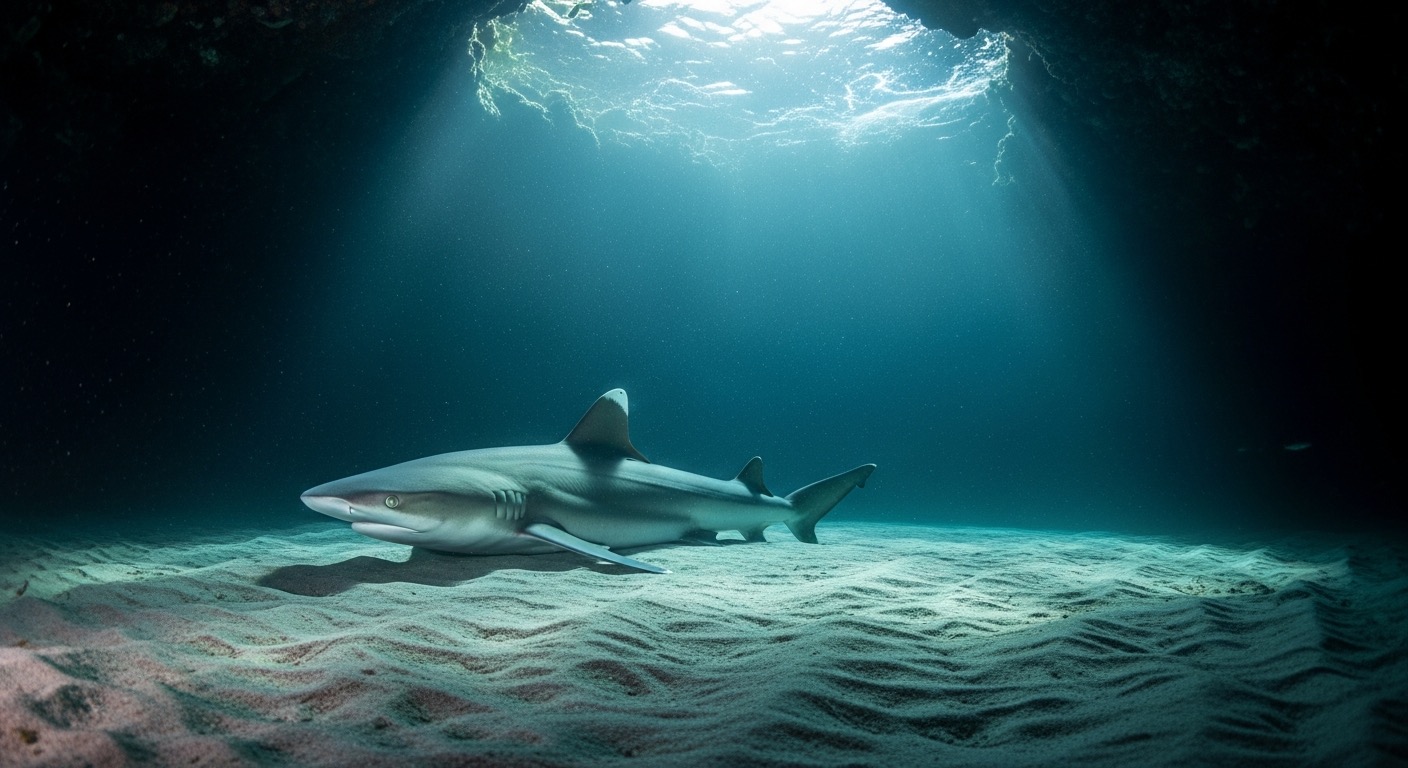
Bottom-dwelling species rest where they feel protected: under coral ledges, inside caves, in sandy channels, or wedged beneath rock overhangs. Whitetip reef sharks are a familiar example for divers, often found stacked motionless in reef caves during daylight before hunting after dark. Nurse sharks pile together in groups, sometimes several deep.
The most famous resting site of all sits off the Yucatán Peninsula, near Isla Mujeres in Mexico. Around 1969, a local fisherman named Carlos García Castilla — known as “Válvula” — reported underwater caves where reef sharks lay still on the bottom, behaviour that seemed impossible for species assumed to need constant motion. The Mexican diver and filmmaker Ramón Bravo confirmed and publicised the find, and the American biologist Eugenie Clark studied the caves during the 1970s. They became known as the “sleeping shark caves.”
Several explanations have been proposed for why sharks gather there: freshwater seeping into the caves may change the water chemistry in a way that makes breathing easier, or may loosen parasites from the sharks’ skin. Divers who visited described the animals as appearing dazed rather than deeply asleep. No single explanation has been settled on.
Open-ocean species have no equivalent refuge. A mako or a blue shark rests, if it rests at all, in open water — which is part of why their sleep is so much harder to study.
Sharks that rest in caves have inspired plenty of bedtime companions. Browse our shark plush collection if you are looking for one that will actually sleep through the night.
When Do Sharks Sleep, and Are Sharks Nocturnal?
There is no single shark schedule. Activity patterns vary by species, and often by season and life stage within the same species.
Several well-known sharks are genuinely nocturnal. Nurse sharks rest through the day and hunt at night, using their barbels and suction feeding to pull prey from crevices in the dark. Whitetip reef sharks follow the same pattern in reverse of most divers’ schedules: still by day, active by night.
Others are crepuscular, meaning they are most active around dawn and dusk. This is a common pattern among predators generally, and low light appears to favour ambush hunters.
Large pelagic sharks tend to be active around the clock, with peaks rather than clean on-off cycles. A great white does not have a bedtime; it has periods of higher and lower activity spread across the day and night.
So the honest answer to “are sharks nocturnal?” is: some are, many are not, and the pattern usually tracks how a species hunts rather than any general rule about sharks.
So do sharks sleep at night? For many of the famous bottom-dwellers it is the reverse — they rest by day and hunt after dark.
How Long Do Sharks Sleep?
Nobody can give you a number, and any article that offers a precise figure is guessing.
Bottom-dwelling species have been observed resting for stretches of hours, particularly during daylight for nocturnal hunters. But “resting for hours” is not the same as “sleeping for hours” — a shark may drift in and out of a genuine sleep state during a long period of stillness, and current methods cannot always tell the difference from the outside.
What the research does suggest is that shark sleep is likely fragmented rather than consolidated. Humans sleep in one long block; many animals do not. Short bouts distributed through the day and night fit both the observed behaviour and the practical constraints of being a predator that also has predators of its own.
And how much do sharks sleep in total? Nobody can say — the daily amount has never been measured for any species.
Do Great White Sharks Sleep?
Great white sharks are obligate ram ventilators, so the question is not whether they stop to sleep — they cannot — but whether they can rest while moving.
The most compelling observation to date came in 2016 off Isla de Guadalupe, Mexico, where a large female great white known to researchers as Emma was filmed at night from a submersible. She was moving slowly into an oxygen-rich current, mouth held open, appearing almost catatonic. Observers described the state as consistent with rest: the current did the work of pushing water over her gills while she expended minimal effort.
If that interpretation holds, it is an efficient solution: face into a current strong enough to ventilate the gills, and the shark gets its oxygen almost for free while remaining nearly passive.
It is worth stressing what this evidence is and is not. It is a plausible, well-documented behavioural observation. It is not a metabolic measurement, and it involves a small number of animals. The claim that great whites sleep while swimming is reasonable — but it has not been demonstrated to the standard reached for smaller, easier-to-study species.
So do sharks sleep while swimming? For an obligate ram ventilator like a great white, that appears to be the only option it has.
Do Whale Sharks Sleep?
Whale sharks are the largest fish in the ocean, and almost everything about their rest remains open.
They are generally described as needing forward motion to ventilate their gills efficiently, which would put them in the same category as great whites: no stopping, so any rest must happen while swimming. Complicating the picture, whale sharks are also capable of feeding by suction while hanging almost vertically in the water, which involves actively drawing water in rather than relying on forward motion.
It is worth being precise about that distinction: suction is documented in whale sharks as a feeding behaviour, not as an established way of ventilating the gills at rest. The two are easily conflated, and the difference is exactly what would settle the question.
Tracking studies have shown whale sharks making deep dives and long periods of slow, steady swimming, and some researchers have suggested these could serve a restorative function. That remains speculation. For an animal this large, this widely travelled and this difficult to observe continuously, the honest position is that we do not yet know how — or how much — whale sharks sleep.
Do Sharks Sleep Upside Down?
No. But there is a real phenomenon behind the question, and it is worth understanding because it is regularly mistaken for sleep.
Turn many shark species onto their back and they enter tonic immobility: the muscles relax, breathing becomes slow and regular, and the animal stops responding for a period of several minutes before recovering. It looks uncannily like sleep, and researchers exploit it deliberately — flipping a shark to work on it safely without sedation.
Tonic immobility is not rest. It is closer to a reflex, a temporary shutdown triggered by the animal’s orientation rather than a state the shark enters by choice. Orcas have been observed using it as a hunting technique against great whites, flipping them upside down to immobilise them.
So a shark on its back is not sleeping. It is stuck.
The Unihemispheric Sleep Myth
You will read in a lot of places that sharks sleep with one half of the brain at a time, keeping the other half awake to swim — a phenomenon called unihemispheric slow-wave sleep.
It is a compelling explanation. It is also, as far as the published evidence goes, not established in sharks.
Unihemispheric sleep is genuinely documented in dolphins and other cetaceans — first shown by EEG in the early 1970s — and in some birds, where one eye stays open and the corresponding brain hemisphere remains active. Those cases were confirmed with EEG recordings, the exact tool that does not translate to shark brains.
The idea appears to have migrated from dolphins to sharks by analogy: both need to keep moving, so surely both solve the problem the same way. But sharks and dolphins are not close relatives, and a shark’s brain is not organised like a dolphin’s. The spinal-cord hypothesis described earlier is a more plausible explanation for how a shark might rest while swimming — and it does not require half a brain to stay awake.
If you see unihemispheric sleep stated as fact about sharks, treat it as an assumption that has been repeated rather than a finding that has been measured.
What Happens If a Shark Can’t Rest?
If sleep serves a purpose, then losing it should have a cost. For sharks, that cost has barely been measured — but the surrounding evidence is suggestive.
In fish where sleep deprivation has been tested experimentally, the pattern mirrors what happens in mammals. Zebrafish kept from resting show a rebound afterwards, sleeping more deeply and for longer than usual once left alone. That rebound is significant: it indicates the animal is running a deficit that has to be repaid, which is one of the defining features of true sleep rather than idle time.
Nobody has run the equivalent experiment on a shark, and for the large species it is difficult to imagine how one would. What exists instead is indirect evidence from handling and capture. Sharks brought aboard for tagging, or held in unsuitable conditions, show elevated stress markers and can take a long time to recover normal behaviour. Whether disrupted rest contributes to that, or is simply one symptom among many, has not been separated out.
There is also a practical dimension for aquariums. Species that need somewhere to settle — a ledge, a cave, a stretch of sand — behave differently when a tank does not provide one. Modern shark exhibits build in resting structures for that reason, on the working assumption that the behaviour matters even where the underlying biology is not fully mapped.
The honest summary is that shark sleep is almost certainly not optional, because sleep-like states are too widespread and too metabolically regulated across vertebrates to be incidental. But the specific consequences of losing it, for any shark species, remain unmeasured.
What We Still Don’t Know
Shark sleep research is young, and the gaps are large.
Most of what has been established comes from small, hardy, bottom-dwelling species that survive well in a lab. Those are precisely the sharks least representative of the ones people ask about. The great whites, makos and whale sharks that dominate the question are the hardest animals in the ocean to observe continuously and the least suited to controlled study.
There is also a measurement problem that will not go away soon. Without a brain-wave signature to rely on, distinguishing genuine sleep from quiet wakefulness in a fish requires either metabolic measurement — which needs a contained animal — or long-duration tagging that captures activity and posture in the wild. Both are advancing, neither is easy.
What can be said with confidence is narrower than most articles admit: some sharks show a measurable resting state that meets the behavioural definition of sleep; the way they achieve it depends heavily on how they breathe; and the popular explanations for how big ocean sharks manage it are still hypotheses. That is less satisfying than a clean answer, but it is where the evidence actually stands.
Sources
- Kelly, M. L., Collins, S. P., Lesku, J. A., Hemmi, J. M., Collin, S. P. & Radford, C. A. (2022). Energy conservation characterizes sleep in sharks. Biology Letters, 18(3), Royal Society.
- Grillner, S., Perret, C. & Zangger, P. (1976), and subsequent work on the spinal generation of swimming in dogfish.
- Mukhametov, L. M. & Supin, A. Y. (1973) — first EEG evidence of unihemispheric sleep in dolphins.
- Rattenborg, N. C. et al. (1999) — unihemispheric sleep and predator detection in mallards.
- Florida Museum of Natural History — Rhincodon typus species profile.