Do Killer Whales Eat Sharks? Inside the Ocean’s Most One-Sided Rivalry
Yes — and when it happens, the fight is remarkably one-sided. Does a killer whale eat a shark? Orcas have been recorded killing great whites, whale sharks and a range of smaller species, and the technique they use is unnervingly precise: flip the shark onto its back to paralyse it, open the body cavity, remove the liver, leave the rest. Great whites have abandoned entire stretches of coastline after a single visit from the right pair of orcas. This guide covers how the hunt works, why the liver, what happened in South Africa, and whether a shark ever wins.
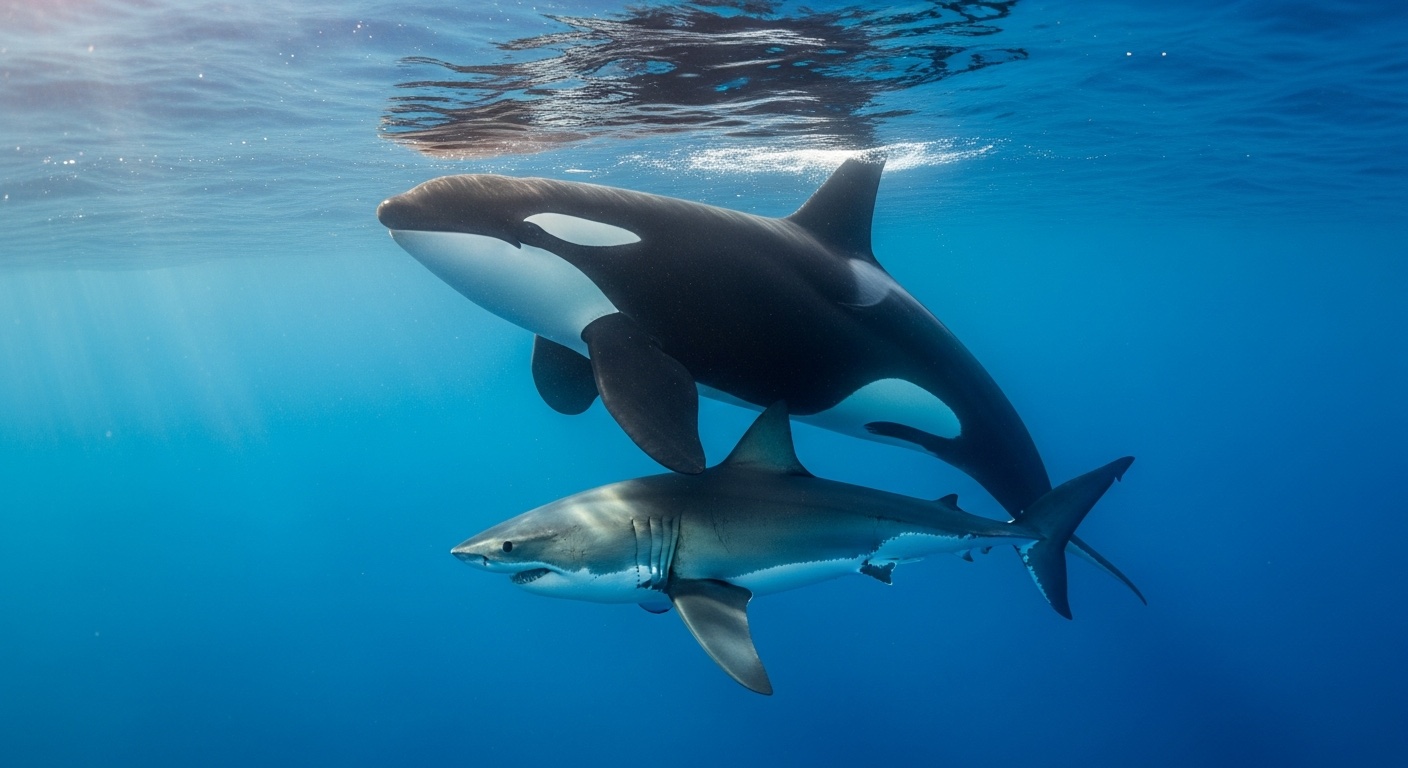
Do Killer Whales Eat Sharks?
Yes, and more often than most people realise.
Orcas have been documented preying on great white sharks, whale sharks, sevengill sharks, blue sharks, makos and a number of smaller species. It is not a universal orca behaviour — different orca populations specialise in wildly different prey, and only some have developed shark hunting. But where a shark-hunting population operates, sharks are on the menu regularly rather than exceptionally.
The relationship is also lopsided in a way that surprises people who think of the great white as untouchable. In the documented encounters between an orca and a great white, the orca has come out ahead.
| Orca | Great white shark | |
|---|---|---|
| Typical adult size | 6–8 m, up to ~6 tonnes (largest males heavier) | 4–5 m, up to ~2 tonnes |
| Brain | Among the largest of any animal; highly social | Small relative to body size |
| Hunting style | Coordinated group tactics, learned and taught | Solitary ambush |
| Speed | Fast in short bursts, high endurance | Fast in ambush bursts |
| Key weapon | Coordination, ramming, precision | Bite force, serrated teeth |
| Known outcome | Prevails in the documented encounters | No documented kill of an adult orca |
The question gets asked in many forms — do orca whales eat sharks, can killer whales eat sharks, can orcas eat sharks — and the answer to all of them is the same: yes, wherever the right population has learned how.
How Orcas Kill a Great White
The hunt exploits a physiological quirk that sharks cannot override.
Turn a shark onto its back and it enters tonic immobility — a reflex state in which the muscles relax, breathing slows, and the animal becomes unresponsive for several minutes. It is not sleep and it is not a decision; it is closer to a switch being flipped. Researchers use it deliberately to handle sharks safely without sedation.
For a shark that must swim to push water over its gills, being held upside down is doubly fatal. It cannot fight back, and it cannot breathe.
Orcas exploit this in at least two ways. Some have been observed inducing the state by holding the shark inverted. In other recorded hunts the approach is more direct: grip the shark by a pectoral fin, roll it, and open the underside.
On 16 May 2022, drone footage from Mossel Bay in South Africa captured the first published direct observation of orcas killing great whites. A group of orcas killed two — possibly three — sharks in roughly seventy minutes. The hunt was a series of targeted strikes, not a prolonged struggle.
What is consistent across cases is the speed. These are not drawn-out battles. A coordinated group of animals that outweigh their target several times over, working a technique they have practised, finish the job in minutes.
Why Do Orcas Eat Shark Liver?
This is the detail that made the story famous, and the explanation is pure arithmetic.
A shark’s liver is enormous. In a great white it can account for up to a third of the animal’s body weight, and it is loaded with squalene — an oil that provides buoyancy in a fish with no swim bladder, and that happens to be extraordinarily energy dense. A single large shark liver can supply an orca with roughly a day’s energy.
Everything else on the shark is comparatively poor value. Muscle is lean, the skeleton is cartilage, and the skin is abrasive enough to damage a predator’s mouth. For a hunter smart enough to be selective, taking the liver and leaving the carcass is not wasteful — it is efficient.
The evidence for the behaviour is physical and unambiguous. Between February and June 2017, five great whites washed ashore around Gansbaai in South Africa. Four had their livers removed through a clean incision between the pectoral fins, the rest of the animal largely intact. Examiners described the precision as surgical.
There is a related question people ask: do orcas kill sharks for fun? The answer, as far as the evidence goes, is no. Taking the highest-value organ and abandoning the rest looks wasteful from the outside, but it is a rational energy strategy for an animal with abundant hunting opportunities.
What Happened in South Africa
The clearest picture of orca-shark predation comes from the South African coast, and it is a story with named individuals.
Two orcas nicknamed Port and Starboard — identifiable by their collapsed dorsal fins, one leaning to each side — have been tracked along the coast since 2009, when they were first recorded off Lüderitz in Namibia.
The sequence is instructive. They began with smaller prey: in 2015, sevengill sharks started washing up in False Bay with their livers removed. Great whites followed in February 2017 at Gansbaai. False Bay’s white shark population then declined over the following years. The Mossel Bay footage came in 2022. And in June 2023, Starboard was recorded killing a great white alone, in about two minutes — a significant escalation, since the technique had been assumed to require coordination between animals.
The consequence nobody predicted was what the surviving sharks did.
Great whites did not simply avoid the individual orcas. They abandoned aggregation sites they had used for years, sometimes within hours of a predation event, and stayed away for weeks or months. False Bay — once one of the most reliable great white sites in the world, famous for sharks breaching clear of the water to take seals — saw white shark presence decline over a period of years.
This is a flight response operating at the scale of a population, and it is one of the most striking demonstrations available that fear alone can reshape a marine ecosystem. The sharks did not need to be eaten in large numbers. The presence of a credible predator was enough to empty the site.
The knock-on effects have since been documented in the scientific literature, and they are substantial. With the great whites gone, sevengill sharks emerged in areas of False Bay where they had never previously been recorded — a new apex predator moving into a vacated role. Cape fur seal sightings increased roughly sixfold, and the seals changed their behaviour, rafting in deep water in a way they had avoided when white sharks patrolled it.
Removing an apex predator from a system does not leave a neat hole. It rearranges everything around it, and False Bay has become one of the clearest natural experiments demonstrating that.
The Other Sharks Orcas Hunt
Great whites get the headlines, but they are not the most frequent target.
Whale sharks — the largest fish in the ocean — are hunted by orcas in the Gulf of California. Four predation events were documented between 2018 and 2024, and a male orca named Moctezuma, first identified in 1992, was present at three of them. The orcas attack the pelvic area to reach the liver. Given that a whale shark can exceed ten metres, it is a striking demonstration of what coordinated hunting achieves against sheer size.
Juvenile great whites appear to be an easier and more regular target than adults. Two hunts in the Gulf of California, in 2020 and 2022, were documented in detail: Moctezuma’s pod killed three young white sharks, using the same sequence — roll the shark, induce tonic immobility, take the liver. The researchers suggest a link to climate, proposing that as water temperatures shift, white shark nursery areas may be moving into waters where orcas already hunt.
Sevengill sharks have been taken in numbers off South Africa, with carcasses again found liver-first. Blue sharks, makos and smaller species appear in the diets of shark-eating orca populations elsewhere. In New Zealand, a resident orca population specialises in rays and small sharks — a reminder that not every shark-hunting orca is going after a great white.
Great white, whale shark, sevengill — the species in this article all turn up in our shark plush collection, minus the teeth.
Why Only Some Orcas Hunt Sharks
Orcas are not one animal behaviourally. This is the fact that explains everything else in this article.
They are also, despite the name killer whale, the largest members of the dolphin family — which makes the answer to do sharks eat dolphins a surprising yes.
Different orca populations, often sharing the same waters, specialise in completely different prey. Some eat almost exclusively fish. Others hunt marine mammals and will not touch fish. Others target rays and sharks. These specialisations come with different calls, different social structures, and different hunting techniques — and they are learned and taught, passed from one generation to the next rather than encoded in the genes.
Biologists describe this as culture, and the word is not a stretch. A young orca in a shark-hunting group learns to hunt sharks because it watches adults do it. A young orca a hundred kilometres away, in a fish-eating group, never learns and never tries.
Two consequences follow, and both matter for how you read shark-orca stories.
First, the threat to sharks is geographically concentrated. In waters where no shark-hunting orca population operates, a great white faces no orca risk at all. The danger is not “orcas” in general; it is specific animals in specific places.
Second, the behaviour can spread. If shark hunting is learned, it can be taught to new individuals and carried into new areas as populations move. That is part of what makes the South African case interesting to researchers — not just what happened, but whether it will happen elsewhere.
Where Else Orcas Hunt Sharks
South Africa produced the clearest evidence, but it is not the only place this happens.
The Gulf of California has become the second major site, and possibly the more active one. Orcas there have been recorded hunting both whale sharks and juvenile great whites, and the events have been documented well enough to enter the scientific literature rather than remaining anecdote. The pattern suggests an established local specialisation rather than isolated opportunism.
California and the northeast Pacific produced the earliest documented case, and it is more solid than its frequent retelling suggests. In October 1997, whale-watchers off the Farallon Islands — a site famous for great whites gathering to hunt seals — watched two orcas kill a white shark and consume its liver. Roughly a hundred great whites left the island for the remainder of the season.
The pattern was confirmed decades later with tracking data: in a subsequent study, seventeen tagged white sharks abandoned the area within hours of an orca appearance and did not return for about a year. The Farallon case established, in 1997, what South Africa would demonstrate again twenty years later.
New Zealand hosts a resident orca population that specialises in rays and small sharks — a useful counterpoint, because it shows that “shark-hunting orca” does not automatically mean “great white hunter”. These animals work shallow coastal water, flipping rays off the bottom, and they are a different behavioural world from the South African animals.
The geographic spread matters for one reason above all. Each of these populations appears to have arrived at shark hunting independently, developing its own version of the technique. That is what you would expect if the behaviour is learned rather than instinctive — and it means there is no reason to think the list of locations is complete.
Why We Only Found Out Recently
For an event this dramatic, orca predation on great whites entered public awareness remarkably late. That gap is worth explaining, because it says something about how ocean science works.
The obvious reason is observation. These hunts happen at sea, often offshore, and last minutes. Before drones were routinely used in marine research, the odds of a scientist being in the right place with a camera were vanishingly small. Almost everything known before the 2020s came from carcasses — sharks washing ashore with their livers missing, which tells you what happened but not how.
Drones changed that. Aerial footage lets researchers watch a hunt unfold from above, in clear water, without disturbing the animals. The direct observations that now anchor the science are a product of the technology as much as of the biology.
There is a second reason, less technical. The great white’s cultural position as the ultimate ocean predator made the idea counterintuitive. When carcasses first appeared with surgical liver removal, the natural assumption was human involvement rather than predation. It took repeated events, in multiple regions, before the pattern was read correctly.
The lesson generalises beyond orcas. The ocean is under-observed, and the absence of recorded behaviour is weak evidence that the behaviour does not occur. There are almost certainly other predator relationships out there that nobody has filmed yet.
Do Great White Sharks Eat Orcas?
No. There is no documented case of a great white killing and eating an adult orca.
The reasons are structural rather than a matter of courage. An adult orca is substantially larger and heavier than any great white, considerably more intelligent, and — decisively — it does not travel alone. A shark attacking an orca is a solitary hunter taking on a coordinated group, each member of which outweighs it.
There is one qualification worth making. Orca calves are vulnerable to large sharks in principle, and adult orcas are known to be highly protective of their young, which suggests the risk is real enough to defend against. But documented predation on orcas by sharks is essentially absent from the record.
The honest framing is that this is not a rivalry between equals. It is a predator and a prey species that happen to look like peers because both are large and both have teeth.
Killer Whale vs Shark: Who Would Win?
On the evidence, the orca — and not narrowly.
Size favours the orca, sometimes by a factor of three in weight. Coordination favours the orca absolutely: a lone shark against a hunting group has no answer. Intelligence favours the orca, which uses a technique refined over generations against a shark relying on a fixed set of instincts. And the orca knows the one physiological weakness — tonic immobility — that a shark cannot train its way out of.
The great white’s advantage is its bite, which is formidable and could seriously injure an orca that made a mistake. But orcas do not fight sharks in the sense of trading blows. They immobilise them first, which is precisely why the encounters are so lopsided.
The most telling evidence is behavioural rather than physical. Great whites, on detecting orcas, leave. Not fight, not posture — leave, and stay gone for months. The animals themselves settled the question long before anyone filmed it.
Sources
- Towner, A. V., Kock, A. A., Stopforth, C., Hurwitz, D. & Elwen, S. H. (2023). “Direct observation of killer whales predating on white sharks and evidence of a flight response.” Ecology 104(1): e3875.
- Towner, A. et al. (2024). “Further insights into killer whales Orcinus orca preying on white sharks Carcharodon carcharias in South Africa.” African Journal of Marine Science 46(1): 1–5.
- Higuera-Rivas, E. et al. (2024). “Killer whales hunt, kill and consume the largest fish on Earth, the whale shark.” Frontiers in Marine Science 11: 1448254.
- Higuera-Rivas, E. et al. (2025). “Novel evidence of interaction between killer whales and juvenile white sharks in the Gulf of California, Mexico.” Frontiers in Marine Science.
- Hammerschlag, N. et al. (2019). “Disappearance of white sharks leads to the novel emergence of an allopatric apex predator, the sevengill shark.” Scientific Reports 9: 1908.
- Hammerschlag, N. et al. (2025). “Evidence of cascading ecosystem effects following the loss of white sharks from False Bay, South Africa.” Frontiers in Marine Science 12: 1530362.
- Jorgensen, S. J. et al. (2019). “Killer whales redistribute white shark foraging pressure on seals.” Scientific Reports 9: 6153.
- Pyle, P., Schramm, M. J., Keiper, C. & Anderson, S. D. (1999). “Predation on a white shark by a killer whale and a possible case of competitive displacement.” Marine Mammal Science 15(2): 563–568.