Hammerhead Shark Facts
With a head unlike anything else in the ocean, the hammerhead is one of the most recognisable sharks alive. Here’s why it looks the way it does, how many kinds there are, and whether it’s really a threat to people.
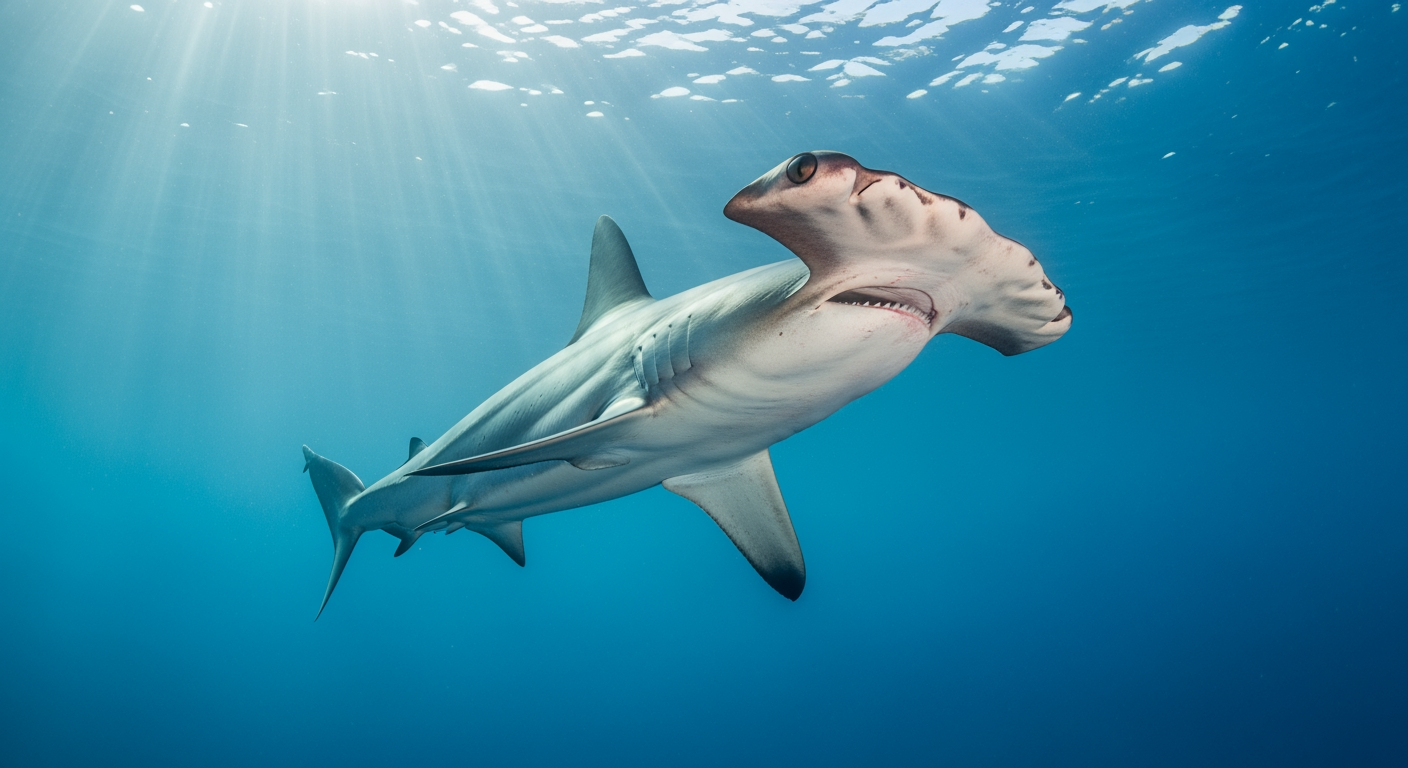
Why the hammer shape?
That wide, flattened head is called a cephalofoil, and it’s not just for show. Spacing the eyes far apart gives hammerheads exceptional, near-360-degree vision — they can essentially see above and below at the same time.
The head also spreads out the shark’s electrical sensors (the ampullae of Lorenzini) across a wider area, turning it into a highly sensitive metal detector for prey hidden in the sand. Many researchers think the shape helps with maneuverability and sharp turns, too.
Not one shark, but several
“Hammerhead” refers to a whole family of sharks — there are around nine species, ranging widely in size. They include the great hammerhead, the scalloped hammerhead, the smooth hammerhead, and the smallest member, the bonnethead, which is barely a metre long.
The great hammerhead is the giant of the group and can exceed 5 metres in length, with a tall, distinctive dorsal fin.
A taste for stingrays
Hammerheads eat fish, squid, crustaceans and other sharks — but they’re famous for hunting stingrays. A great hammerhead will use its wide head to pin a ray against the seabed before eating it, and seems largely unbothered by the rays’ venomous barbs.
Interestingly, the bonnethead is one of the only sharks known to digest plant matter, eating significant amounts of seagrass alongside its prey.
Schooling by the hundred
Most sharks are loners, but scalloped hammerheads are famous for gathering in enormous schools during the day — sometimes hundreds strong — around seamounts and islands. It’s one of the great spectacles of the underwater world.
The honest answer
Despite their size and dramatic appearance, hammerheads are rarely a danger to humans — the attack records list just 18 unprovoked bites and no fatalities for the whole genus. We break down the full picture, species by species, in Are Hammerhead Sharks Dangerous?
A species in trouble
Several hammerhead species are now endangered or critically endangered. They’re heavily affected by the shark-fin trade and by accidental capture in fishing gear, and their tendency to school makes them especially vulnerable. Protecting them is a growing conservation priority.
Can’t get enough of that unmistakable head? See our guide to the best hammerhead shark plush.