Do Sharks Eat Dolphins? Separating the Myth From the Evidence
Yes, and more often than the popular story suggests. Tiger sharks, bull sharks and great whites all prey on dolphins, and researchers surveying wild populations find that a large share of adult dolphins carry shark bite scars. What they do not find is the relationship most people believe in — the idea that sharks are afraid of dolphins and flee when a pod appears. That belief is widespread, it is repeated by major aquariums, and the scientists who have actually measured it describe it as an old sailor’s myth. This guide covers what really happens when the two meet.
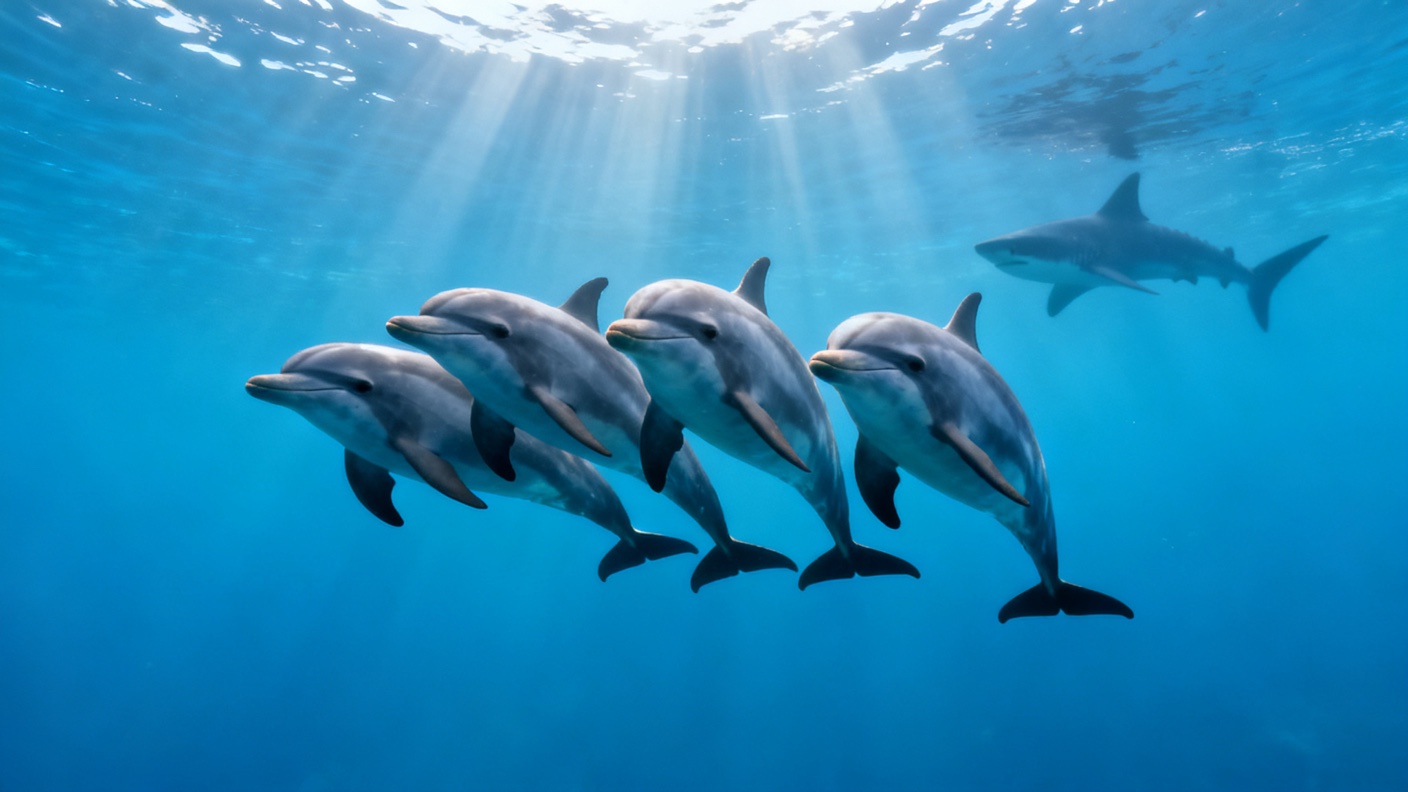
Do Sharks Eat Dolphins?
Yes. Several large shark species prey on dolphins, and the evidence is written on the dolphins themselves.
Surveys of wild dolphin populations routinely find a substantial proportion of adults carrying healed shark bite scars — animals that were attacked and survived. The rates vary enormously by location, from around 15 to 35 percent in Florida and the Bahamas to roughly 74 percent of adults in Shark Bay, Western Australia.
Those are the survivors. The ones that did not survive are not available to be counted, which means the scarring rate is a floor on predation, not a measure of it.
Three species account for most of it:
Tiger sharks are the most consistent dolphin predators. Their diet is famously indiscriminate and their jaws handle large prey without difficulty.
Bull sharks take dolphins in coastal and estuarine water, where both species spend time.
Great whites prey on dolphins as part of a marine mammal diet that also includes seals and sea lions.
But the answer needs a qualifier that changes everything. Sharks do not generally attack healthy adult dolphins in a pod. They target the vulnerable: calves, sick or injured animals, and individuals separated from the group. That distinction is the whole story, and it is where the popular myth gets its foothold.
The question comes in a few forms — does sharks eat dolphins, will a shark eat a dolphin given the chance — and the answer to each is the same yes, with the same qualifier about which dolphins.
Are Sharks Afraid of Dolphins?
You will read constantly that sharks fear dolphins and will not enter water where a pod is present. Some of the largest aquarium websites in the world publish this. It is, on the evidence, wrong.
The most direct test came from long-term research in Shark Bay, Western Australia, where tiger sharks and bottlenose dolphins share the same waters and both have been studied for decades. The finding was the reverse of the folklore: dolphins actively avoid areas when tiger sharks are abundant, changing where they feed and how they use the habitat according to shark presence.
Michael Heithaus, the researcher behind much of that work, has been blunt about the popular belief. Speaking to Discover Magazine, he described the idea that sharks fear dolphins as essentially an old sailor’s myth — and said that what his team found was the reverse: the dolphins were the ones that were afraid.
The published work backs it. Heithaus and Dill’s 2002 study in Ecology showed that bottlenose dolphins in Shark Bay shifted their habitat use according to tiger shark predation risk, trading better feeding grounds for safer ones when sharks were abundant.
Where does the myth come from? Probably from three real things, misread.
Dolphins do defend themselves successfully, and a group mobbing a shark is a genuine phenomenon. Dolphins are more agile than sharks in short manoeuvres, which is visible to anyone watching. And dolphins are charismatic, which makes people want them to win.
None of that adds up to fear. A shark that leaves a pod of alert adult dolphins alone is making a cost-benefit calculation, not fleeing. There are easier meals.
Shark vs Dolphin, Who Would Win?
The honest answer is that it depends almost entirely on the numbers and the individuals, which is why the question is asked so often and answered so badly.
| Large shark | Dolphin | |
|---|---|---|
| Weapon | Jaws with serrated teeth; a single bite can be decisive | Rostrum used as a battering ram; teeth used for gripping, not cutting |
| Tactics | Ambush; usually attacks from below and behind | Coordinated group defence; repeated ramming strikes |
| Agility | Fast in a straight line; wide turning circle | Highly manoeuvrable; can turn inside a shark |
| Social structure | Almost always alone | Almost always in a pod |
| Endurance | Ectothermic; low energy demand | Warm-blooded; must surface to breathe |
| Typical outcome | Wins against a calf or isolated animal | Group prevails against a single shark |
The pattern that emerges is not “shark beats dolphin” or the reverse. It is that a lone dolphin loses and a pod usually wins.
A dolphin’s defence is ramming. It accelerates and drives its rostrum into the shark’s gills or soft underbelly — the two most vulnerable areas on the animal. Repeated strikes from several dolphins can injure a shark seriously enough to end the encounter.
What a dolphin cannot do is bite through a shark. Dolphin teeth are conical, designed to grip fish, not to cut. Every offensive option a dolphin has is blunt force.
How Dolphins Fight Back
Dolphin anti-predator behaviour is genuinely sophisticated, and it does not depend on winning a fight.
Group formation comes first. Pods close ranks around calves and vulnerable individuals, presenting a shark with a wall of large animals rather than an isolated target. For an ambush predator that relies on surprise and a single decisive strike, this is close to a dealbreaker.
Mobbing is the active response. Several dolphins converge on a shark and ram it in sequence, striking the gills and underside. It is not an attempt to kill, it is an attempt to make the shark leave — and it usually works.
Vigilance and avoidance do most of the work, and this is the part the myth omits entirely. Dolphins track shark presence and change their behaviour accordingly: feeding in different areas, moving into shallower water where large sharks cannot follow, and staying alert. The best defence is not being where the shark is.
Echolocation underpins all of it. Dolphin sonar has an effective range measured in the tens to hundreds of metres and works in complete darkness or murky water, well beyond what vision offers. A predator whose entire strategy depends on surprise has a serious problem against prey that can detect it long before it arrives.
That last point is worth dwelling on. The dolphin’s real advantage is not its rostrum. It is that ambush rarely works against an animal with sonar.
Tiger shark, bull shark, great white — the species in this article all have a gentler version in our shark plush collection.
Do Dolphins Eat Sharks?
Mostly no — with one enormous exception.
Ordinary dolphins do not eat sharks. Bottlenose dolphins and their relatives eat fish and squid; their teeth cannot process a shark and their body size makes it a poor idea. A dolphin that injures a shark in defence does not then eat it.
The exception is that the orca is a dolphin. Despite the name killer whale, orcas belong to the dolphin family, and they are the largest member of it — which means the answer to “do dolphins eat sharks” is technically yes, and spectacularly so.
Orcas hunt great whites, whale sharks and a range of smaller species, flipping them to induce tonic immobility and removing the liver. Great whites have abandoned entire coastlines after orca predation events. The full account is in do killer whales eat sharks.
So the family tree produces a genuinely strange situation. The animals people imagine defending swimmers from sharks mostly cannot harm a shark at all — while their largest relative is the only animal on Earth that systematically hunts the great white.
Do Dolphins Protect Humans From Sharks?
There are documented accounts of dolphins circling swimmers while sharks were nearby, and some of these stories are credible and well witnessed.
What is missing is evidence that the dolphins were protecting anyone.
Two explanations fit the observations without requiring altruism toward humans. Dolphins circle and mob anything they perceive as a threat in their vicinity, including threats to themselves — a swimmer inside that circle is inside it incidentally. And dolphins are curious about people in the water generally, approaching swimmers in the absence of any shark at all.
There is also a reporting problem that should make anyone cautious. A swimmer who is circled by dolphins and comes home unharmed tells the story. A swimmer who is circled by dolphins and is bitten anyway does not attribute anything to the dolphins. The cases that support the belief are the only ones that get told.
None of this makes the accounts false. It makes them insufficient. The honest position is that dolphins sometimes behave in ways that may incidentally benefit a nearby human, and that no one has demonstrated intent.
Which Dolphins Get Taken
Predation concentrates on specific individuals, and knowing which ones explains the whole relationship.
Calves are the primary target. A newborn dolphin is small, slow and inexperienced, and this is precisely why pods form defensive rings around them. In populations where shark predation is high, calf mortality is correspondingly high.
Sick and injured animals are the second category. A dolphin that cannot keep up with the pod, or cannot manoeuvre normally, has lost the two things that keep it alive.
Isolated individuals are the third. A dolphin separated from its group — through injury, disorientation or simply bad luck — faces a shark alone, and alone is where dolphins lose.
The distinction matters because it reframes the whole question. Sharks are not avoiding dolphins out of fear. They are doing what every efficient predator does: waiting for a target that can be taken at acceptable cost, and ignoring the ones that cannot.
What Bite Scars Reveal
The most useful data on shark predation of dolphins does not come from watching attacks. It comes from photographing dolphins.
Researchers who survey wild populations catalogue individuals by their dorsal fins, which carry unique nicks and notches — and in the process they record the scars. Shark bites leave a distinctive signature: a crescent of parallel punctures, or a clean semicircular chunk missing, healed over. Once you know the pattern, it is unmistakable.
The results are striking, and they vary sharply by place. In Shark Bay, Western Australia, a survey of adult bottlenose dolphins found that around 74 percent carried shark bite scars — roughly three animals in four, most of the wounds attributable to tiger sharks. In Sarasota Bay, Florida, the figure was about 35 percent. Off Bimini in the Bahamas, around 29 percent of bottlenose dolphins and 15 percent of Atlantic spotted dolphins.
These are animals that were attacked, escaped, and lived long enough to be photographed years later.
Two conclusions follow, and the second is easy to miss.
First, attacks are common. Predation on dolphins is not a rare event that happens somewhere else; it is a routine feature of life in shark waters.
Second, dolphins survive them often. A scarred dolphin is a failed shark attack. The scarring rate tells you how many attempts fail, not how many succeed — and given how many failures are recorded on living animals, the shark’s success rate against a healthy adult appears low.
That is the statistical version of the point this whole article turns on. Sharks attack dolphins frequently. They frequently do not win.
Do Sharks Eat Whales?
The question follows naturally and the answer splits cleanly in two.
Living large whales are essentially safe from sharks. An adult humpback or blue whale is orders of magnitude larger than any shark, and no shark attempts one. Calves are a different matter: a great white or tiger shark will take a whale calf given the opportunity, which is one reason whales calve in shallow, warm, well-defended waters.
Dead whales are another story entirely, and they produce some of the most remarkable feeding events in the ocean. A whale carcass floating at the surface is an enormous, defenceless mass of blubber, and it draws sharks from a wide area.
A decade of observations off Seal Island in South Africa documented up to forty great whites visiting a single carcass over one day, with as many as five feeding simultaneously. What the researchers did not see was aggression: the sharks tolerated each other even when they physically collided, sorting access by size — the largest animals taking the fattiest blubber near the tail. For a shark that may go weeks between meals, a dead whale is a windfall on a scale nothing else matches.
Small cetaceans — porpoises, and the smaller dolphin species — sit in the same category as dolphins generally. They are within range for a large shark, and they rely on the same defences: group living, agility and vigilance.
The pattern across all of it is consistent. Sharks are opportunists constrained by size. What they eat is decided less by preference than by what they can physically handle, and a healthy adult whale is simply out of reach.
The Places Sharks and Dolphins Overlap
Predation is not evenly distributed. It concentrates where the two animals share habitat, and a few places have become natural laboratories for studying it.
Shark Bay, Western Australia is the most studied of all. Tiger sharks and bottlenose dolphins occupy the same shallow seagrass banks, and decades of continuous research there produced most of what is known about how dolphins respond to shark presence. It is where the landscape-of-fear work was done, and where the popular myth was tested and failed.
Florida comes up in searches constantly, and for good reason. Bull sharks and bottlenose dolphins overlap heavily in Florida’s coastal and estuarine waters — bays, inlets and river mouths where both species hunt.
South Africa and Australia’s east coast put dolphins alongside great whites, adding a large ambush predator to the mix. The dynamic differs from the tiger shark situation: great whites hunt differently, and encounters are less frequent but more decisive.
The common factor is water depth. Shark predation on dolphins concentrates in shallow coastal habitat — precisely where dolphins feed and calve, and where large sharks can still operate. Open ocean, where dolphins travel in large fast-moving pods, is comparatively safe.
Which produces a small irony worth noting. The places dolphins choose for raising calves — shallow, warm, full of food — are exactly the places where the sharks that eat calves can reach them.
What This Relationship Actually Shows
The shark-dolphin relationship has become a case study in how predator presence shapes prey behaviour, and that is more interesting than the fight it is usually reduced to.
The Shark Bay research demonstrated what ecologists call the landscape of fear: prey animals do not simply get eaten or not eaten, they change where they go and what they do based on where predators are. Dolphins in that system feed in less productive but safer habitat when tiger sharks are abundant, accepting a worse diet in exchange for a lower chance of being killed.
The consequence runs further than the dolphins. Where dolphins choose to feed affects the fish they eat and the seagrass beds they disturb, which means a tiger shark influences a habitat it never touches. Removing the sharks would not simply mean more dolphins — it would mean dolphins feeding in different places, with effects rippling outward.
This is the same mechanism visible when orcas arrive and great whites vacate a coastline, one level up the food chain. Fear moves animals, and moving animals reshape ecosystems.
Which brings the myth back into focus. The story that sharks fear dolphins gets the relationship exactly backwards — and in doing so, it obscures one of the better-documented examples of how ocean ecosystems actually work.
Sources
- Heithaus, M. R. (2001). “Shark attacks on bottlenose dolphins (Tursiops aduncus) in Shark Bay, Western Australia: attack rate, bite scar frequencies, and attack seasonality.” Marine Mammal Science 17(3): 526–539.
- Heithaus, M. R. & Dill, L. M. (2002). “Food availability and tiger shark predation risk influence bottlenose dolphin habitat use.” Ecology 83(2): 480–491.
- Heithaus, M. R. (2001). “Predator–prey and competitive interactions between sharks and dolphins: a review.” Journal of Zoology 253(1): 53–68.
- Wilkinson, K. A. et al. (2017). “Shark bite scar frequency in resident common bottlenose dolphins in Sarasota Bay, Florida.” Marine Mammal Science 33(2): 678–686.
- Melillo-Sweeting, K. et al. (2022). “Examining shark bite scars on dolphins off Bimini, The Bahamas.” Marine Mammal Science 38(1): 18–28.
- Fallows, C., Gallagher, A. J. & Hammerschlag, N. (2013). “White sharks scavenging on whales and its potential role in further shaping the ecology of an apex predator.” PLOS ONE 8(4): e60797.
- Au, W. W. L. (1993). The Sonar of Dolphins. Springer-Verlag.
- Discover Magazine (2024) — interview with Michael Heithaus.