What Do Sharks Eat? A Prey-by-Prey Guide
What does a shark eat? It depends almost entirely on which shark you mean. A great white hunts seals and sea lions. A hammerhead specialises in stingrays. A nurse shark sucks crabs and lobsters out of crevices. And the two largest sharks in the ocean — the whale shark and the basking shark — eat plankton, filtering water for animals barely visible to the eye. There is no single shark diet, only a set of strategies that scale with body size, jaw shape and habitat. This guide covers what food sharks eat, prey by prey, and answers the specific questions people ask about each one.
What Food Do Sharks Eat?
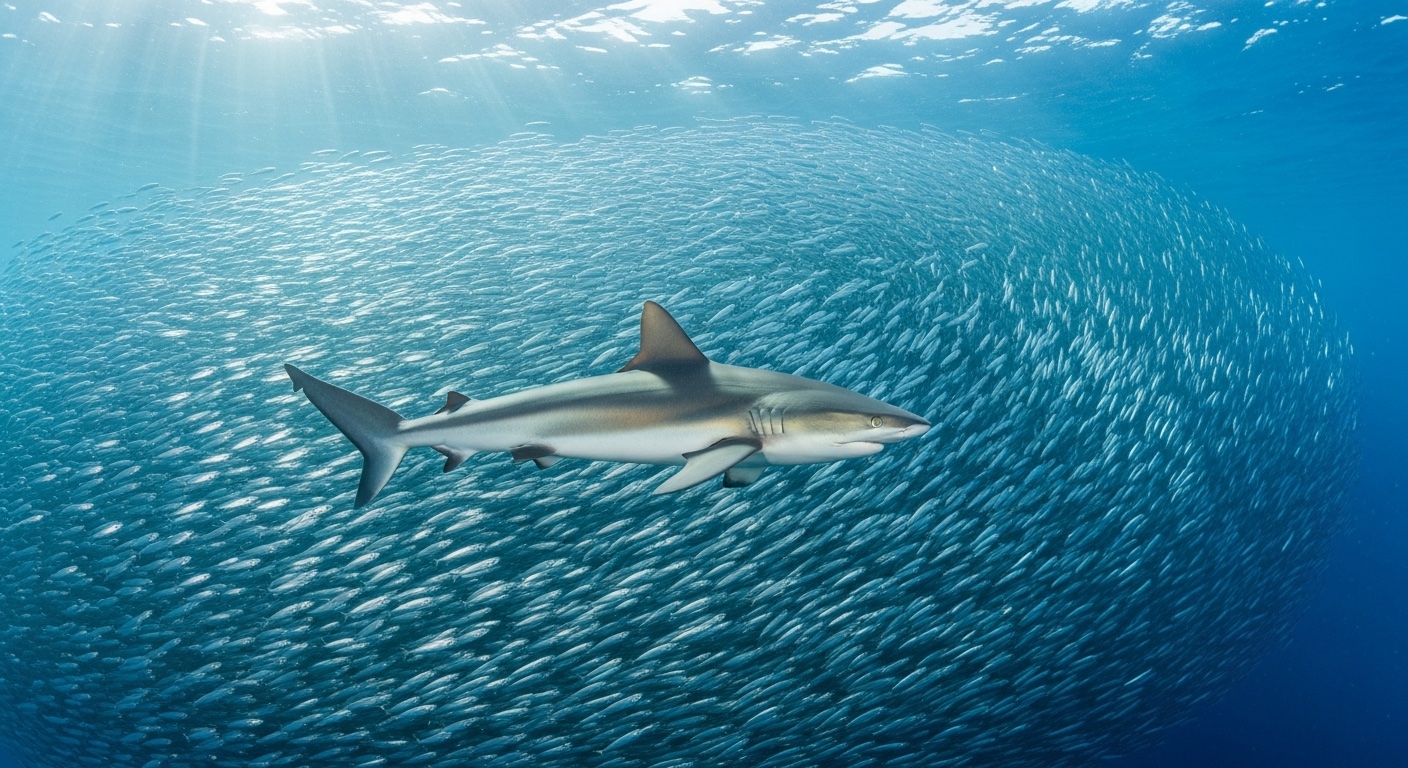
Almost all sharks are carnivores, and the great majority of what sharks eat is fish. Bony fish and smaller sharks make up the bulk of the diet across the group, from reef species taking small prey to open-ocean hunters chasing schooling fish.
Beyond that staple, the diet broadens according to what a species is equipped to catch:
Marine mammals — seals, sea lions and occasionally small whales — are taken by a handful of large species, the great white above all.
Cephalopods — squid, cuttlefish and octopus — are a major food source, particularly for deep-water and open-ocean sharks.
Crustaceans — crabs, lobsters, shrimp — dominate the diet of smaller bottom-dwelling species.
Rays and skates are the specialty of hammerheads and several other species.
Sea turtles are taken by tiger sharks, which have the jaws for it.
Molluscs, sea urchins and seabirds appear in the diets of various opportunists.
Plankton feeds the three largest sharks in the ocean, which brings us to the biggest exception in the group.
| Prey type | Which sharks eat it | Notes |
|---|---|---|
| Bony fish | Almost all species | The dietary staple of the group |
| Other sharks and rays | Great white, tiger, bull, hammerhead | Includes cannibalism within species |
| Seals and sea lions | Great white, a few other large species | High-fat prey; a specialist target |
| Squid and octopus | Deep-water and pelagic species | Major food source, often overlooked |
| Crabs and lobsters | Nurse, bamboo, horn, bonnethead | Suction feeding and crushing teeth |
| Sea turtles | Tiger shark above all | Requires jaws able to crush shell |
| Jellyfish | Some pelagic species, opportunistically | Low energy value; not a staple |
| Seabirds | Tiger shark, occasionally others | Taken at the surface |
| Plankton | Whale shark, basking shark, megamouth | Filter feeders; the largest sharks of all |
| Seagrass | Bonnethead | The only shark known to digest plant matter |
People phrase the question in all sorts of ways — what does shark eat for food, what does sharks eat, what do shark eat — and the honest answer is the same: it depends on the species, but fish leads the list.
Fish, Squid and Everyday Prey
Strip away the dramatic examples and the ordinary shark diet is fish.
Most sharks are mid-sized predators eating mid-sized prey. A blacktip reef shark works the shallows for small reef fish. A blue shark crosses ocean basins feeding largely on schooling fish and squid. Even the great white spends its juvenile years eating fish almost exclusively — the switch to marine mammals comes with size, not with the species.
Squid deserve more attention than they usually get. For many pelagic and deep-water sharks, cephalopods are as important as fish, and in some species more so. Squid are abundant, soft-bodied, and available at depths where other prey is scarce. Nobody has measured total prey mass across all sharks, but the arithmetic is hard to argue with: squid are eaten by a huge range of abundant species, seals by only a handful. Cephalopods almost certainly outweigh marine mammals in the group’s overall diet, however little attention they get.
The way sharks catch this prey varies as much as the prey itself. Some pursue and chase. Some ambush from below. Bottom-dwellers suck prey out of crevices by expanding the mouth cavity — the nurse shark is powerful enough at this to pull a conch clean out of its shell. Filter feeders do not catch individual prey at all.
Do Sharks Eat Seals?
Yes, and it is the most studied predatory relationship in the shark world.
Great whites are the main seal hunters, and their technique is well documented: approach from deep water where the shark is invisible against the dark, accelerate vertically, and strike upward with enough force to breach clear of the surface. The hunt is decided in a single strike.
The reason is energy. Seal blubber is extraordinarily calorie-dense, and a large seal represents days of energy in one meal for a shark that hunts opportunistically rather than continuously. For a great white, one successful hunt is worth many failed fish chases.
This appetite is also why great whites gather where seals gather — the aggregation sites off South Africa, California and Australia are all seal colonies. And it is why those same sites attract the animals that hunt great whites, a chain we follow in what eats sharks.
Not every shark can do this. Taking a seal requires size, speed and jaws capable of a killing bite. Most sharks are simply not equipped for it.
Do Sharks Eat Turtles?
Yes — and one species in particular.
Tiger sharks are the main predator of sea turtles, and they are among the very few animals capable of it. A turtle’s shell defeats nearly everything in the ocean, but a tiger shark’s teeth are distinctively shaped: broad, heavily serrated and notched, built to saw through hard material rather than slice through flesh. It is the same dentition that lets them handle bone and shell generally.
Where tiger sharks and nesting turtles overlap, the relationship is a well-documented seasonal one. Sharks concentrate near nesting beaches when turtles gather to breed.
Do sharks eat sea turtles other than tiger sharks? Occasionally — a large great white or bull shark may take a juvenile turtle — but only the tiger shark does it routinely, and only it has the equipment to make an adult turtle worth attempting.
Do Sharks Eat Octopus and Jellyfish?
Both, and the answers are more interesting than a simple yes.
Octopus are eaten by a range of sharks, particularly bottom-dwelling and reef species that hunt in the same rocky terrain octopuses inhabit. It is not a one-sided relationship: octopuses have been recorded killing and eating small sharks, and an octopus that gets its arms around a shark’s gills has a real advantage. Most encounters go the shark’s way; not all of them do.
Jellyfish are eaten opportunistically by several pelagic species, and this is where a common assumption breaks down. Jellyfish are mostly water and provide very little energy per bite, which is why almost no predator specialises in them. But “low value” is not “no value”, and sharks moving through a bloom will feed on what is abundant. In the open ocean, abundance often beats quality.
Neither prey appears in most shark diet articles — including the pages currently ranking first for this question — which says more about how those articles are written than about what sharks actually eat.
Do Sharks Eat Crabs and Shellfish?
Yes, and for a large number of species this is the main diet.
The sharks that eat crustaceans are the ones you rarely see in documentaries: nurse sharks, bamboo sharks, horn sharks, bonnetheads, catsharks. They are small to medium, they live on or near the bottom, and their teeth are flattened for crushing rather than pointed for cutting.
Their hunting method is suction. By rapidly expanding the mouth and throat cavity, the shark creates a pressure drop strong enough to pull prey out of a crevice — no chasing required. Horn sharks crush sea urchins with such regularity that the pigment stains them: both their teeth and their dorsal spines turn purple. You can read a horn shark’s diet off its own body.
The bonnethead goes further than any other shark. As covered in do sharks lay eggs, it does not merely swallow seagrass while chasing crabs — it digests and assimilates it, making it the only shark known to be genuinely omnivorous.
The Sharks That Eat Plankton
The three largest sharks in the ocean do not hunt at all.
Whale sharks, basking sharks and megamouth sharks are filter feeders. They swim with the mouth open, passing water over specialised structures that trap plankton, small fish and larvae, then swallow what is caught. Measurements off the Yucatán put the rate at roughly 326 cubic metres of water per hour for a 4.4-metre animal, rising to over 600 for a larger one — hundreds of cubic metres an hour, not the thousands often quoted.
These are also the three largest sharks alive: whale sharks reach around 18 metres, basking sharks have been reliably measured at over 12, and megamouths reach five to seven.
The irony is worth stating: the animals people find most intimidating on sight are the ones that could not eat a person if they tried. A whale shark’s throat is surprisingly narrow — only a few centimetres across — and its thousands of tiny teeth play no role in feeding at all.
This is also the answer to a question people ask constantly. Do whale sharks eat people? No — they are physically incapable of it, and divers swim alongside them routinely.
Filter feeding has evolved independently several times in the sea, in whales, in rays, and in these sharks. When prey is small and abundant enough, filtering beats hunting.
Whale shark, great white, tiger, hammerhead — every species in this guide has a friendlier counterpart in our shark plush collection.
What Different Sharks Eat
Diet varies so much between species that “shark diet” is nearly meaningless as a category. A few examples make the point.
Great white — fish as a juvenile, seals and sea lions as an adult, plus other sharks and occasional whale carcasses. The shift with age is one of the most dramatic dietary changes in the group.
Tiger shark — the most indiscriminate large shark. Sea turtles, fish, seabirds, rays, other sharks, and a well-earned reputation for swallowing inedible objects. Their nickname, the ocean’s garbage can, is unkind but not unfounded. It preys on dolphins too — a relationship wrapped in myth, which we untangle in do sharks eat dolphins.
Hammerhead — stingrays above all, along with fish, squid and crustaceans. A great hammerhead will pin a ray to the seabed with its head before eating it. More detail in hammerhead shark facts.
Bull shark — highly varied, including fish, other sharks, rays and turtles. Its tolerance for fresh water gives it access to prey no other shark encounters.
Nurse shark — crustaceans, molluscs and small fish, taken by suction from the seabed at night.
Greenland shark — fish and squid, plus the strangest stomach contents in the group. Examined animals have yielded reindeer, including antlers, along with polar bear, horse and elk remains. These are almost certainly scavenged rather than hunted: carcasses that fell into the water or animals that drowned. A shark that swims slowly enough to be outpaced by a walking human is not chasing down a reindeer.
How Much Do Sharks Eat?
Far less than most people assume.
Sharks are ectothermic — their body temperature tracks the water around them — which means they spend nothing on staying warm. A mammal of equivalent size burns a large share of its intake simply maintaining body heat; a shark does not. The energy saving is enormous, and it shows up directly in how little a shark needs to eat.
Estimates for many species land in the range of one to ten percent of body weight per week rather than per day — figures drawn largely from animals in captivity, where intake can be measured directly. A large predatory shark may go days to weeks between substantial meals, particularly after taking high-energy prey like a seal.
One caveat is worth flagging, because the old figure still circulates. A classic estimate suggested a great white could live for weeks on a single fatty meal. Later work revised that sharply upward: white sharks burn energy faster than assumed and need to feed more often than the original calculation implied.
A few of the fast-swimming species are partial exceptions. Great whites, makos and other lamnid sharks practise regional endothermy: they keep their swimming muscles, viscera and eyes warmer than the surrounding water. It improves muscle performance and lets them hunt in colder seas, but it raises the energy bill — and their intake reflects it.
The practical consequence matters for anyone worried about sharks: a shark is not a constantly hungry animal looking for its next meal. Most of the time, it has recently eaten and is not looking for anything.
What Sharks Don’t Eat
People are on almost no shark’s menu.
Humans are not a natural prey item for any shark species. We are bony, low in fat compared with a seal, and unfamiliar. The bites that do occur are overwhelmingly single, exploratory and followed by withdrawal — an animal investigating an unfamiliar object with the only tool it has, then abandoning it.
The mistaken identity hypothesis is best established for great whites: a person on a surfboard, seen from below in poor light, presents a silhouette not unlike a seal. Once the shark has made contact, it discovers the mistake — which is exactly why so many bites are single and non-fatal.
Sharks also decline plenty of genuine marine prey. Sea snakes, certain toxic fish, and some hard-shelled animals go untouched by species not equipped for them. And filter feeders take nothing larger than a few centimetres, regardless of what swims past.
How Sharks Actually Catch Their Food
Diet is only half the story. How a shark eats determines what it can eat, and there are four broadly different approaches across the group.
Ambush is the great white’s method and the most dramatic. The shark positions itself deep, where its dark back makes it invisible against the seabed, identifies a target silhouetted against the bright surface, and accelerates vertically. Everything depends on the first strike; a seal that sees the shark coming usually escapes, since seals are more agile in the water than the animal hunting them.
Pursuit suits the fast open-ocean species. Makos are among the fastest fish in the ocean and run down schooling fish and squid in open water, where there is nowhere for prey to hide and speed is the only thing that matters.
Suction is the bottom-dweller’s technique, and it is more powerful than it sounds. By rapidly expanding the mouth and throat, the shark generates a pressure drop that pulls prey out of crevices — no chase, no struggle, and access to prey wedged in places no other predator can reach. Nurse sharks generate enough suction to extract a conch from its shell.
Filtering requires no catching at all: swim, open, strain, swallow.
Teeth follow the method. A great white’s teeth are broad triangles with coarse serrations, built for removing a chunk from something large. A mako’s are narrow, smooth and curved, designed for gripping slippery fish. A tiger shark’s are notched and heavily serrated, capable of sawing through turtle shell. A nurse shark’s are small and flattened for crushing. Show a specialist a shark tooth and they can usually tell you what the animal ate.
Sharks also replace teeth continuously through life — a lost tooth is simply rotated forward from the row behind. Over a lifetime, a single shark can get through tens of thousands of them, which is why fossilised shark teeth are so common on beaches.
A Shark’s Diet Shifts as It Grows
One of the most consistent findings in shark biology is that a species does not have a single diet. It has a sequence of them.
The great white is the clearest case. Juveniles have narrow, pointed teeth suited to gripping fish, and they eat fish almost exclusively. Somewhere around three metres, the teeth broaden into the familiar serrated triangles, and the diet shifts toward marine mammals. The change is not a preference developing — it is anatomy making a new prey type possible.
This has a consequence people rarely consider: a juvenile great white and an adult great white occupy different ecological positions entirely. One is a fish predator competing with other mid-sized hunters. The other is an apex predator eating seals. They are the same species at different points of the same life.
The same pattern recurs across the group. Young tiger sharks eat smaller and softer prey before graduating to turtles. Juvenile hammerheads take small fish and invertebrates before specialising in rays.
Location shifts the diet too. Bull sharks in fresh water eat what fresh water offers, which is not what the same species eats offshore. Tiger sharks near a turtle nesting beach in season eat differently from tiger sharks in open water three months later. Sharks are opportunists working within the constraints of their anatomy, and the constraint is usually more informative than the preference.
Sources
- Motta, P. J. et al. (2010). “Feeding anatomy, filter-feeding rate, and diet of whale sharks Rhincodon typus during surface ram filter feeding off the Yucatan Peninsula, Mexico.” Zoology 113(4): 199–212.
- Semmens, J. M. et al. (2013). “Feeding requirements of white sharks may be higher than originally thought.” Scientific Reports 3: 1471.
- Carey, F. G. & Teal, J. M. (1969). “Mako and porbeagle: warm-bodied sharks.” Comparative Biochemistry and Physiology 28: 199–204.
- Bernal, D. et al. (2001). “Analysis of the evolutionary convergence for high performance swimming in lamnid sharks and tunas.” Comparative Biochemistry and Physiology A 129: 695–726.
- Leigh, S. C., Papastamatiou, Y. P. & German, D. P. (2018). “Seagrass digestion by a notorious ‘carnivore’.” Proceedings of the Royal Society B 285: 20181583.
- Leclerc, L.-M. E. et al. (2012). “Characteristics and stomach contents of Greenland sharks (Somniosus microcephalus) caught in Svalbard, Norway.” Polar Biology 35: 1197–1208.
- SeaWorld — “Sharks & Rays: Diet & Eating Habits.”
- Florida Museum of Natural History — species profiles (tiger shark, great white, nurse shark, horn shark).
- ReefQuest Centre for Shark Research — horn shark diet and pigment staining.