What Eats Sharks? The Predators of the Ocean’s Predator
Sharks sit near the top of the ocean food chain, but nothing is truly untouchable. Orcas hunt great whites and eat their livers. Sperm whales, saltwater crocodiles, large groupers and even octopuses have all been recorded taking sharks. Other sharks are among the most reliable shark predators of all — including, in some species, before birth. And one predator kills around 80 million sharks a year — more than every other animal on this list combined, which is the part most articles leave out.
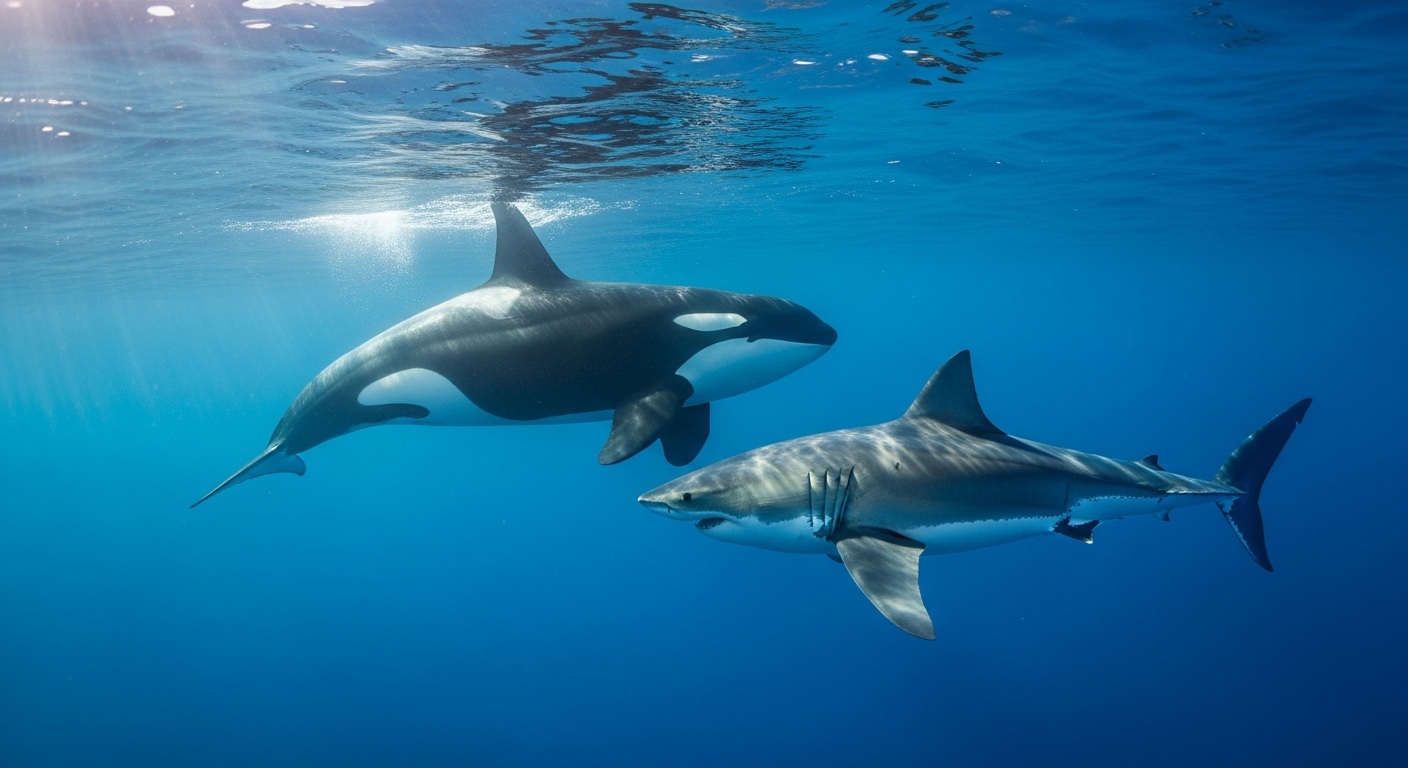
What Eats Sharks?
Several animals do, and the list is longer than most people expect.
The main natural predators of sharks are orcas, larger sharks, sperm whales, saltwater and Nile crocodiles, and a scattering of opportunists — large predatory fish, seals, octopuses and, remarkably, animals that raid shark eggs on the shoreline.
But the honest answer to what eats sharks has to include the predator that dwarfs all the others. Humans kill sharks on a scale no marine animal comes close to, and any list that leaves us off it is answering the question incompletely.
| Predator | How it takes a shark | Which sharks are affected |
|---|---|---|
| Orca (killer whale) | Coordinated attack; flips the shark to induce tonic immobility, then extracts the liver | Great whites, other large sharks |
| Larger sharks | Direct predation; also cannibalism within a species | Juveniles and smaller species especially |
| Sperm whale | Deep-water predation; opportunistic | Deep-sea and mid-water species |
| Saltwater / Nile crocodile | Ambush in estuaries and river mouths | Bull sharks and other coastal species |
| Large predatory fish | Opportunistic, mainly on juveniles | Newborns and small species |
| Seals and sea lions | Occasional, mainly on small or juvenile sharks | Small coastal species |
| Octopus | Rare, opportunistic; recorded in captivity and in the wild | Small sharks |
| Egg predators (whelks, fish, shore-raiding mammals) | Consume egg cases before hatching | Egg-laying species |
| Humans | Fishing — targeted and as bycatch | All species; the dominant cause of shark mortality |
The rest of this article works through them, starting with the one that has genuinely changed how biologists think about the great white.
People ask it a dozen ways — what eat sharks, what eats a shark, what feeds on them — and it is always the same short list of animals bigger or cleverer than the shark in front of them.
Orcas: The Shark That Eats Sharks
Orcas are the only animal known to hunt great white sharks systematically. The technique exploits a quirk of shark physiology: flip a shark onto its back and it enters tonic immobility, unable to fight or breathe. The orcas then open the body cavity and take the liver — an organ up to a third of the shark’s body weight and packed with energy-dense oil — leaving most of the carcass behind.
The behaviour is learned and confined to specific orca populations rather than shared by all orcas, and where it operates great whites have abandoned entire coastlines for months. We cover the full story — the named South African orcas, the filmed hunts, the ecological fallout and whether a shark ever wins — in do killer whales eat sharks.
Sharks Eat Sharks
If you had to name the animal that eats the most sharks after humans, the answer would be other sharks.
Large species prey on smaller ones routinely. A great white will take a smaller shark without hesitation; tiger sharks are famously indiscriminate and eat other sharks among everything else; bull sharks take smaller sharks in coastal water. For a juvenile shark, the most dangerous animal in the neighbourhood is usually an adult of a larger shark species.
Cannibalism within a species is also well documented. Adults eat juveniles of their own kind, which is one of the reasons nursery areas matter so much — shallow coastal habitats keep young sharks away from the adults that would otherwise eat them, including their own relatives.
The most extreme version happens before birth. In sand tiger sharks, the largest embryo in each uterus consumes its siblings during development, so the mother gives birth to two pups that have already eaten their way to that point. We go into the mechanics in do sharks lay eggs, but it belongs here too: for a sand tiger, the first shark that eats you is your sibling.
This is also why the food-chain diagrams that put “shark” in a single box at the top are misleading. Sharks occupy multiple levels of the same food web at once, and a shark’s position depends entirely on its size and age. For the other side of that web — everything a shark hunts rather than everything that hunts it — see what do sharks eat.
The ocean’s food web is more tangled than the diagrams suggest — and the animals in it make for a good collection. Browse our shark plush collection for the species in this article.
Why Juvenile Sharks Are the Real Prey
Nearly everything on the predator list becomes far more relevant when the shark in question is young, and this is the single most important thing to understand about shark predation.
A newborn shark is small, inexperienced, and edible by a very wide range of animals. Depending on species it may be anywhere from twenty centimetres to a metre and a half at birth — impressive for a fish, and unimpressive next to a large grouper, an adult shark or a crocodile. Mortality in the first year is high across most species.
This is the reason nursery areas exist and matter. Many sharks give birth in shallow coastal habitat — mangroves, estuaries, seagrass beds, sheltered bays — and the young remain there for months or years. The water is too shallow for the large predators that would eat them, including adult sharks of their own species, and there is enough small prey to grow on. The mother provides no protection whatsoever; what she provides is a postcode.
Egg-laying species face the same problem in a different form. A case anchored to the seabed cannot flee, cannot hide, and has to survive months of exposure with nothing but a leathery wall between the embryo and whatever finds it. The tough capsule and the anchoring tendrils are the entire defence strategy, and it is not a complete one.
The pattern holds across the whole group. Predation on sharks is overwhelmingly predation on young sharks. By the time a large species reaches adult size, the list of animals capable of eating it has shrunk to almost nothing — which is precisely what “apex predator” describes.
What Happens When Sharks Are Removed
Predation on sharks matters beyond the individual animals, because of what sharks do in the systems they live in.
Predators shape ecosystems in two ways. The obvious one is by eating prey and keeping its numbers in check. The less obvious one — and often the more powerful — is by changing prey behaviour. Animals that live near a predator feed differently, move differently and avoid certain areas entirely. Ecologists call this the landscape of fear, and it can restructure a habitat even when very few animals are actually eaten.
The orca events described earlier are a demonstration of exactly that, one level up the chain. Great whites did not need to be eaten in large numbers to leave a site; the presence of a predator was enough. Whatever those sharks had been doing in that ecosystem stopped when they left.
What happens when sharks are removed at scale is a genuinely contested question, and it is worth being straight about that rather than repeating the tidy version.
The famous case is a 2007 Science paper proposing that the decline of large sharks along the US east coast released cownose rays from predation, and that the resulting ray population collapsed a scallop fishery. It became the textbook example of a marine trophic cascade — and it was challenged in 2016 by a detailed reassessment which found that the scallops had begun declining before the rays increased, that bivalves appeared in under three percent of ray stomachs, and that cownose rays reproduce far too slowly to have exploded in the way described.
That does not mean removing sharks has no consequences. It means the specific chain in that specific case does not hold up, and anyone citing it as settled science is a decade behind the literature.
Better supported are the behavioural effects. Work in Shark Bay, Australia, has shown that the presence of tiger sharks changes where dugongs and turtles graze, which in turn affects the seagrass beds they feed on — an influence exerted through risk rather than through the number of animals eaten. That is the same landscape-of-fear mechanism visible in the orca events, one level up the chain.
The point for this article is simple enough. A shark being eaten by an orca is a natural event that ocean ecosystems have absorbed for millions of years. Sharks being removed by the tens of millions is not, and the difference shows up well beyond the sharks themselves.
Sperm Whales and Other Marine Mammals
Sperm whales are the largest toothed predator on Earth, diving to great depth in pursuit of squid — and their reputation as shark predators should be kept in proportion.
Shark remains do turn up in sperm whale stomachs. Studies of stranded animals have found deep-water species, particularly dogfish, along with the occasional egg case. But the sperm whale diet is dominated overwhelmingly by cephalopods, and the shark remains are best read as occasional and opportunistic rather than as evidence of active shark hunting. A sperm whale that encounters a dogfish at depth may well eat it; it is not searching for one.
Direct observation is impossible for the obvious reason: these encounters happen hundreds or thousands of metres down, in darkness, far from any camera.
Seals and sea lions also appear on the list, which surprises people who think of them exclusively as shark food. Large males of some species will take small or juvenile sharks, and there is footage of seals killing small sharks. The relationship is not one-directional — it depends on which animal is bigger.
Crocodiles Kill Sharks
Saltwater crocodiles and Nile crocodiles both take sharks, and the encounters happen where their ranges overlap with coastal shark habitat: estuaries, river mouths, mangrove channels.
Bull sharks are the species most exposed, and for a specific reason. Bull sharks are among the very few sharks that tolerate fresh water, swimming far up rivers where no other shark follows. That adaptation opens habitat to them — and delivers them into water where large crocodiles are the resident ambush predator.
Photographs of crocodiles with sharks in their jaws surface regularly from northern Australia and parts of Africa. It is the kind of encounter that reads as impossible until you remember that a large saltwater crocodile outweighs most sharks it will meet in an estuary.
Octopuses, Fish and Egg Raiders
Some shark predators are genuinely surprising.
Octopuses have been recorded killing and eating small sharks, both in aquariums and in the wild. An octopus is not fast, but it is strong, dexterous and capable of grappling a shark of comparable size — and unlike the shark, it can wrap around an opponent from every direction at once.
Large predatory fish take juvenile sharks. Groupers in particular are ambush hunters that swallow prey whole, and a newborn shark is within range for a large one. The point applies broadly: a shark’s first weeks of life are its most dangerous, and almost anything bigger is a threat during them.
Egg predators are the category most people never think of. An egg-laying shark leaves its case anchored to the seabed for months with no protection at all, and plenty of animals will take it. Marine snails bore neat holes through the leathery capsule — a real but minor cause of egg mortality, quantified at around two percent in studies that have measured it. Fish swallow cases whole, and egg cases have been recovered from seals and sea lions.
The strangest predator on the list lives on land. In South Africa, chacma baboons have been observed working the shoreline at low tide, pulling shark egg cases out of the kelp and eating them. A land primate preying on sharks is about as far from the food-chain diagram as you can get.
Where Sharks Are Most at Risk
Predation on sharks is not spread evenly across the ocean. It concentrates in particular places, and knowing which ones explains most of the pattern.
Coastal shallows are the most dangerous water for young sharks and the safest for them at the same time — a contradiction that resolves once you separate the threats. Shallow nurseries exclude large sharks and orcas, which is the point. But they are full of the mid-sized predators that eat newborns: groupers, larger coastal fish, and in some regions crocodiles.
Estuaries and river mouths are where the crocodile encounters happen. They are also where bull sharks concentrate, which is why that species accounts for a disproportionate share of crocodile-shark interactions.
Seal colonies are a special case, because they invert the expected relationship. Great whites gather near seal colonies to hunt, and those same aggregations are what draw shark-hunting orcas. The shark comes for the seals; something else comes for the shark.
The deep ocean is the least understood. Sperm whales hunt at depths where observation is nearly impossible, and the deep-water sharks they encounter are among the least studied fish in the world. Whatever the real rate of predation is down there, we are almost certainly underestimating it.
The open ocean surface is where human fishing dominates. Longlines set for tuna and swordfish cross thousands of kilometres of pelagic water, and pelagic sharks — blue sharks, makos, oceanic whitetips — are caught in enormous numbers as bycatch. No natural predator operates at that scale in that habitat.
The geography also explains why some sharks are barely preyed upon at all. A deep-water species that never enters shallow water, never approaches a seal colony and is too small to interest a sperm whale may face almost no natural predation as an adult. Its main risk, like everything else on this list, is a fishing net.
Humans Are the Sharks’ Main Predator
Everything above is real, and all of it together is a rounding error next to human fishing.
The most recent global assessment, published in Science in 2024, put shark fishing mortality at roughly 80 million sharks in 2019 — rising to around 100 million once unidentified catches are included. The figure had increased since 2012 despite a decade of new regulation. More than 30 percent of that mortality falls on threatened species.
You will often see “100 million sharks a year” quoted as a flat fact. That number comes from a 2013 study, which gave a range of 63 to 273 million and settled on roughly 100 million as a central estimate. It is not wrong, but it is a decade old, and the 2024 work is the better figure to cite.
A large share of these deaths comes from bycatch — sharks caught unintentionally in longlines and nets set for tuna and swordfish. But the 2024 analysis identified a shift worth noting: an increasing proportion of catch is now deliberately targeted, driven by demand for shark meat rather than fins alone. Whole populations have declined sharply, and many species are now listed as endangered or critically endangered.
The imbalance is worth stating plainly. An orca might take a handful of sharks. A crocodile takes what wanders into its estuary. Human fishing removes sharks at a rate that no natural predator has ever approached, and it does so faster than slow-reproducing animals can replace themselves — a shark that produces a couple of pups every other year cannot absorb that pressure.
There is a mirror-image question people ask alongside this one: are sharks predators to humans? The records say barely. Unprovoked bites number in the dozens per year worldwide and fatalities in the single digits — a comparison we work through in are hammerhead sharks dangerous.
Set the two numbers side by side and the asymmetry is total. We are not on the shark’s menu. It is very much on ours.
So Are Sharks Still Apex Predators?
Yes, and the apparent contradiction is worth unpicking.
An apex predator is an animal with no natural predators as a healthy adult in its own environment. The qualifiers carry the definition. A great white is an apex predator; a great white pup is prey for a range of animals including other great whites. Both statements are true at once.
Being an apex predator has never meant invulnerability. It means that no animal systematically hunts you as its main food source when you are full grown. Orcas kill great whites, but great whites are not a staple of the orca diet — the sharks are an occasional, specialised target for particular orca groups.
Apex predators are also, by definition, rare. Each level of a food chain loses most of the available energy, so the top level supports very few animals. That scarcity is precisely why removing them causes disproportionate change: there were never many to begin with.
Which brings the answer back around. What is the biggest predator in the ocean? By raw impact on shark populations, it is not an ocean animal at all.
Sources
- Worm, B. et al. (2024). “Global shark fishing mortality still rising despite widespread regulatory change.” Science 383(6690): eadf8984.
- Worm, B. et al. (2013). “Global catches, exploitation rates, and rebuilding options for sharks.” Marine Policy 40: 194–204.
- Towner, A. V., Kock, A. A., Stopforth, C., Hurwitz, D. & Elwen, S. H. (2023). “Direct observation of killer whales (Orcinus orca) predating on white sharks (Carcharodon carcharias) and evidence of a flight response.” Ecology 104(1): e3875.
- Myers, R. A., Baum, J. K., Shepherd, T. D., Powers, S. P. & Peterson, C. H. (2007). “Cascading effects of the loss of apex predatory sharks from a coastal ocean.” Science 315(5820): 1846–1850.
- Grubbs, R. D. et al. (2016). “Critical assessment and ramifications of a purported marine trophic cascade.” Scientific Reports 6: 20970.
- Evans, K. & Hindell, M. A. (2004). “The diet of sperm whales (Physeter macrocephalus) in southern Australian waters.” ICES Journal of Marine Science 61(8): 1313–1329.
- Marine Dynamics / Dyer Island Conservation Trust (Gansbaai) — white sharks stranded with livers removed, 2017.
- Save Our Seas Foundation — “What eats sharks?” (World of Sharks).