Do Sharks Lay Eggs? The Three Ways Sharks Reproduce
Some do, most do not. Around 40 percent of shark species lay eggs, sealing their young inside leathery cases that wash up on beaches as “mermaid’s purses.” The rest give birth to live young — and among those, some nourish their pups through a placenta like a mammal while others let them hatch from eggs held inside the mother’s body. That third category is where most confusion comes from, and it is where the interesting biology lives. This guide breaks down all three methods, which sharks use which, and what shark eggs actually look like.
Do Sharks Lay Eggs?
Yes, but only a minority of them.
Estimates put the proportion of egg-laying shark species at around 40 percent. The remaining 60 percent of the more than 500 known shark species give birth to live young instead — by one of two quite different routes.
So the answer to “do sharks lay eggs or give birth” is: both, depending on the species. And that is not a dodge — it reflects one of the more remarkable facts about sharks. Few animal groups display such variety in how they reproduce. Within a single class of fish you find species that lay eggs and abandon them, species that carry their young internally on a yolk supply, and species that grow a placenta and nourish their pups through an umbilical cord, exactly as a mammal does.
Biologists sort this variety into three modes, and getting them straight is the difference between understanding shark reproduction and repeating a half-remembered fact.
And do sharks have eggs in the first place? Every shark produces eggs — the only question is whether the female lays them or keeps them inside until the pups are ready.
The Three Ways Sharks Reproduce
Oviparity is egg-laying in the ordinary sense. The female produces an egg encased in a tough protective capsule, deposits it on the seabed or among seaweed, and leaves. The embryo develops entirely on the yolk inside the case and hatches on its own. There is no parental care after the egg is laid.
Viviparity is live birth with a placental connection. The embryo develops inside the mother, attached by a structure that functions like a mammalian placenta and umbilical cord, receiving nutrients directly from her bloodstream. This is as close to mammalian pregnancy as fish get.
Ovoviviparity — increasingly called aplacental viviparity — sits between the two, and it is the one people get wrong. The mother produces eggs, but instead of laying them, she retains them inside her body. The embryos develop on their own yolk supply, hatch internally, and are then born live. From the outside it looks identical to live birth. Internally, it is closer to egg-laying with the eggs kept in.
That middle category is where most popular accounts go wrong. Because the birth looks identical to placental live birth, sources routinely lump the two together and say sharks “give birth to live young” without qualification. It is accurate as a description of what you would see from outside, and misleading about what is actually happening inside.
The three modes are also more evenly balanced than most articles suggest. Egg-laying is the single largest category at roughly 40 percent of species; the two live-bearing modes split the remaining 60 percent between them at around 30 percent each. So live birth wins overall — but no single method is the runaway majority.
| Reproduction mode | What happens | Roughly how common | Example species |
|---|---|---|---|
| Oviparity (egg-laying) | Egg cases laid and abandoned; embryo lives on yolk | ~40% — the largest single group | Catsharks, horn sharks, bamboo sharks, swell sharks, zebra sharks |
| Ovoviviparity (aplacental) | Eggs retained inside the mother; hatch internally; born live | ~30% | Great white, tiger shark, whale shark, basking shark, mako, nurse shark |
| Viviparity (placental) | Embryo fed through a placental connection, like a mammal | ~30% | Hammerheads, bull shark, blue shark, lemon shark, most requiem sharks |
One species in that table is worth flagging, because it is frequently misclassified elsewhere: the nurse shark gives birth to live young, despite being a bottom-dwelling shark of exactly the type that usually lays eggs.
It is also the answer to a question people phrase in different ways — are sharks born in eggs, or born live? Some hatch from a case; the rest arrive live.
What Do Shark Eggs Look Like?
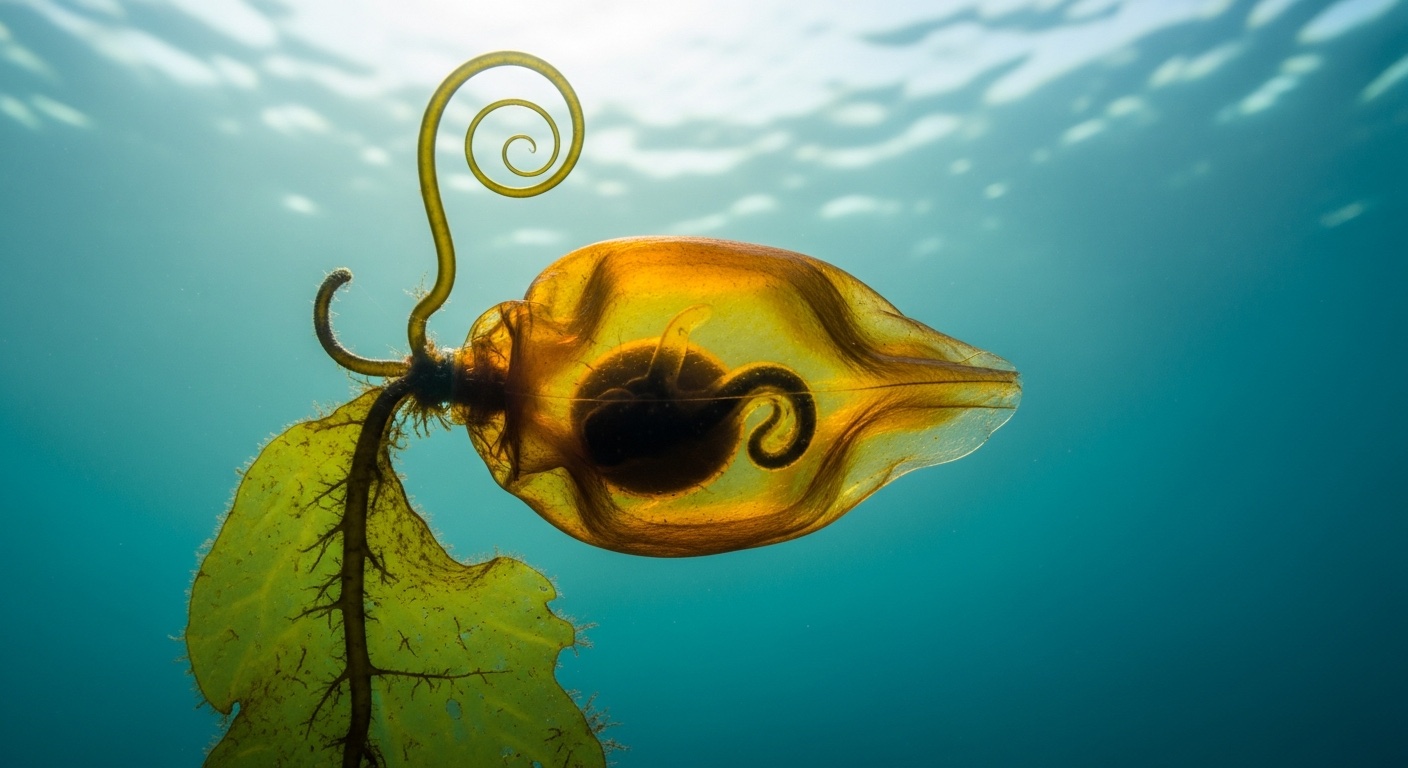
If you have walked a beach after a storm and picked up a dark, rubbery rectangle with curling threads at the corners, you have handled a shark egg case.
These are the mermaid’s purses — the common name for the egg capsules of egg-laying sharks and their relatives, the skates. They are made of collagen, tough and leathery rather than brittle, and they are built to survive months in moving water. The tendrils at the corners are anchors: the female wedges the case into seaweed, coral or rock, and the threads tangle and hold it in place while the embryo develops inside.
The shape varies by species enough that it can be used for identification, and beachcombers in several countries contribute finds to citizen-science projects that map local shark and skate populations from washed-up cases.
Most of the purses found on beaches are empty. The case has done its job, the young shark has hatched and swum away, and the capsule has come loose and drifted ashore. Finding one is evidence of a nursery nearby rather than of a failed egg.
Mermaid’s purses are a favourite find for young beachcombers — and shark biology tends to hook them for good. Our shark plush collection covers the species they will want to read about next.
The Sharks That Lay Corkscrews
Not every shark egg is a purse. Horn sharks produce one of the most peculiar structures in the ocean: a spiral egg case shaped like an auger or a screw.
Horn sharks belong to the genus Heterodontus, and the behaviour has been observed directly: the female takes the freshly laid case in her mouth and works it into a narrow crevice in the rock. The detail that makes it work is timing. The case is soft when laid and hardens after it is wedged in place, so it moulds to the crevice first and sets afterwards. The spiral flanges then act like a threaded plug, making the case extremely difficult for a predator to pull back out.
It is a mechanical solution to a problem every other egg-laying shark solves with tendrils and hope.
Which Sharks Lay Eggs?
Egg-laying is concentrated in smaller, bottom-dwelling sharks — the species that live on or near the seabed and have somewhere to anchor a case.
Catsharks are the largest group of egg-layers, a family of small, slender sharks found worldwide. Horn sharks produce the spiral cases described above. Bamboo sharks and epaulette sharks, both common in aquariums, lay purses that are frequently hatched under observation — which is why so much footage of shark eggs exists. Swell sharks lay cases with translucent walls, and the developing embryo can sometimes be seen moving inside if you hold one up to the light. Zebra sharks lay large, dark cases anchored with dense fibrous tufts.
The pattern behind the list is straightforward. Laying eggs requires a place to put them. A shark that spends its life in open ocean has no seabed to anchor to and no reef to wedge into, so open-water species have almost universally evolved to carry their young instead.
If you are asking what sharks lay eggs, the answer is a short and consistent list of small, bottom-living families.
Do Great White Sharks Lay Eggs?
No. Great whites are ovoviviparous: the female produces eggs, retains them internally, and gives birth to live pups.
There is a further detail that makes great white reproduction genuinely strange. The developing embryos consume unfertilised eggs produced by the mother during gestation — a behaviour called oophagy, or egg-eating. The pups are, in effect, fed a steady supply of eggs inside the uterus, and they emerge large and fully capable: gestation runs an estimated twelve to eighteen months, litters number between two and ten, and newborns measure over 1.2 metres.
The species remains difficult to study on this point. Pregnant great whites are rarely observed and no birth has been filmed in the wild — though in 2024, a drone off the California coast captured footage of what may have been a newborn shortly after birth. Much of what is known still comes from a small number of examined specimens.
Do Tiger Sharks Lay Eggs?
No — tiger sharks are also ovoviviparous, and they are one of the more prolific sharks in the ocean. Where a great white might produce a handful of pups, a tiger shark can carry a litter running into the dozens.
That gap illustrates something worth understanding about shark reproduction generally: there is a trade-off between the number of young and the investment in each. Sharks that produce few, large, well-developed pups give each one a strong chance of survival. Sharks that produce many, smaller pups accept higher losses.
When Shark Pups Eat Each Other
The sand tiger shark takes internal development to a conclusion that sounds invented.
Its embryos develop inside two uteri, and as they grow, the largest and most developed embryo in each begins to consume its siblings. By the time the mother gives birth, a single pup emerges from each uterus — two in total, each one large, experienced, and having already killed to get there.
Biologists call this intrauterine cannibalism, or adelphophagy. It is an extreme version of the same trade-off described above: rather than producing many small pups, the sand tiger produces two extremely capable ones, and the selection happens before birth rather than after.
The behaviour was first described in the 1940s and remains, as far as is known, unique to this species — no other shark has been found to do it.
How Long, and How Many?
Shark gestation is long by fish standards and long by most standards.
Many species carry their young for nine to twelve months. Several run considerably longer, and one holds a record worth stating carefully. A 1990 study of frilled sharks from Suruga Bay in Japan estimated gestation in that deep-water species at around three and a half years — which, if the estimate is right, would be the longest of any vertebrate. It is worth stressing that this is a figure derived from embryo growth rates across a large sample, not a pregnancy anyone has watched from beginning to end.
Litter size varies as widely as everything else. At one end sits the sand tiger with its two survivors. At the other, whale sharks: a single female examined off Taiwan in 1995 was carrying around 300 embryos, which remains the record for any shark and settled a long-running argument about whether the species laid eggs at all.
Egg-laying species work differently again. Rather than a single large clutch, many lay a small number of cases at a time — often two — and repeat over an extended breeding season, so the annual total accumulates gradually.
Sharks That Reproduce Without a Male
Female sharks in aquariums have produced viable pups with no male present.
The phenomenon is called parthenogenesis — reproduction from an unfertilised egg — and it has been confirmed in several shark species held in captivity, verified by genetic testing showing the pups carried only their mother’s DNA.
The first documented case involved a bonnethead, the smallest hammerhead species. A pup was born in a US aquarium in 2001 to a female that had been kept without males, and genetic analysis published in 2007 confirmed there was no paternal DNA. A blacktip shark followed in 2008, and further cases have since been recorded in other species including zebra sharks.
Whether this happens in the wild is unclear, and there is a plausible argument that it is a last resort rather than a routine strategy — pups produced this way have reduced genetic diversity, which is a poor long-term bet for a population. But it does mean that “sharks need a male to reproduce” is not universally true.
Do Sharks Lay Eggs on Land?
No, never. Every shark egg case is deposited in the water, and it has to stay there: the embryo inside depends on seawater flowing through the case for oxygen.
The confusion is understandable, because the cases that people actually find are almost always on a beach. But a mermaid’s purse on the sand is a case that has finished its work and washed up afterwards, not one that was laid there. A shark cannot leave the water to lay, and an egg case out of water will not develop.
Slow Reproduction Is a Conservation Problem
There is a practical reason this biology matters beyond curiosity.
Sharks reproduce slowly. Long gestations, small litters, and late sexual maturity mean that populations recover from losses far more slowly than bony fish, which spawn thousands of eggs at a time. A species that produces two pups every other year cannot absorb heavy fishing pressure the way a species producing millions of eggs can.
That is the underlying reason so many shark populations have declined sharply and recovered slowly. The reproductive strategy that works well in a stable ocean — few young, heavily invested in — becomes a liability when adults are removed faster than they can be replaced.
Live Birth Does Not Make Them Mammals
One of the most common follow-up questions to shark reproduction is whether sharks are mammals — and it is easy to see where it comes from. An animal that gives birth to live young, and in some cases feeds them through a placenta, ticks two boxes people associate with mammals.
Sharks are fish. Specifically they are cartilaginous fish, a group whose skeletons are made of cartilage rather than bone, and they are separated from mammals by hundreds of millions of years of evolution. They breathe with gills, they are not warm-blooded in the mammalian sense, and they do not produce milk.
What the shared traits actually illustrate is convergent evolution: two unrelated lineages arriving at the same solution because the same problem favours it. Carrying young internally protects them from predation and lets them emerge large and capable. That is a good strategy whether you are a shark or a whale, and evolution has found it more than once.
The placental connection in requiem sharks is a particularly striking case. It is not inherited from a common ancestor with mammals — it evolved independently, from the yolk sac, and it performs the same job by a different route. Two very different animals, same answer.
Where Shark Pups Go
Whether a shark hatches from a case or is born live, what happens next follows a common pattern.
Many species use nurseries: shallow, sheltered coastal areas — mangroves, estuaries, bays, seagrass beds — where young sharks spend their first months or years. The appeal is straightforward. The water is too shallow for large predators, including adult sharks of their own species, and there is enough small prey to grow on.
Females of several species return to specific nursery areas to give birth, and there is evidence that some return to the area where they themselves were born. Young sharks then remain in the nursery until they are large enough to move into open water.
There is no parental care in any of this. A shark that gives birth in a nursery leaves immediately, and the pups are entirely independent from the first minute. What the mother provides is a location, not protection.
This is also where shark reproduction runs into human activity most directly. Mangroves, estuaries and shallow bays are exactly the coastal habitats most affected by development, and a nursery lost is a generation of sharks with nowhere safe to grow. For animals that already reproduce slowly, losing the nursery compounds the problem.
Sources
- Natural History Museum, London — “Do sharks lay eggs?” (Discover) — reproduction modes and mermaid’s purses.
- The Shark Trust — “Shark Reproduction” and the Great Eggcase Hunt.
- Joung, S.-J., Chen, C.-T., Clark, E., Uchida, S. & Huang, W. Y. P. (1996). “The whale shark, Rhincodon typus, is a livebearer: 300 embryos found in one ‘megamamma’ supreme.” Environmental Biology of Fishes 46: 219–223.
- Chapman, D. D., Shivji, M. S., Louis, E., Sommer, J., Fletcher, H. & Prodöhl, P. A. (2007). “Virgin birth in a hammerhead shark.” Biology Letters 3(4): 425–427.
- Chapman, D. D., Firchau, B. & Shivji, M. S. (2008). “Parthenogenesis in a large-bodied requiem shark, the blacktip Carcharhinus limbatus.” Journal of Fish Biology 73(6): 1473–1477.
- Tanaka, S. et al. (1990). “The reproductive biology of the frilled shark, Chlamydoselachus anguineus, from Suruga Bay, Japan.” Japanese Journal of Ichthyology 37(3): 273–291.
- Springer, S. (1948). “Oviphagous embryos of the sand shark Carcharias taurus.” Copeia 1948(3): 153–157.
- Gauna, C. & Sternes, P. C. (2024). “Novel aerial observations of a possible newborn white shark (Carcharodon carcharias) in Southern California.” Environmental Biology of Fishes 107: 249–254.
- Australian Museum — Port Jackson shark (Heterodontus portusjacksoni), spiral egg case behaviour.
- Florida Museum of Natural History — species profiles (great white, sand tiger, whale shark).