Are Hammerhead Sharks Dangerous? What the Records Show
Hammerhead sharks look alarming and are, by the numbers, among the least dangerous large sharks in the ocean. The International Shark Attack File attributes 18 unprovoked bites to the entire hammerhead genus, and none of them were fatal — a record that puts hammerheads far behind great whites, tiger sharks and bull sharks. The nuance worth knowing is that “hammerhead” covers several species of very different size, and only the largest of them is treated with genuine caution by divers. This guide walks through what the records actually show, why bites are so rare, and how to behave if you meet one in the water.
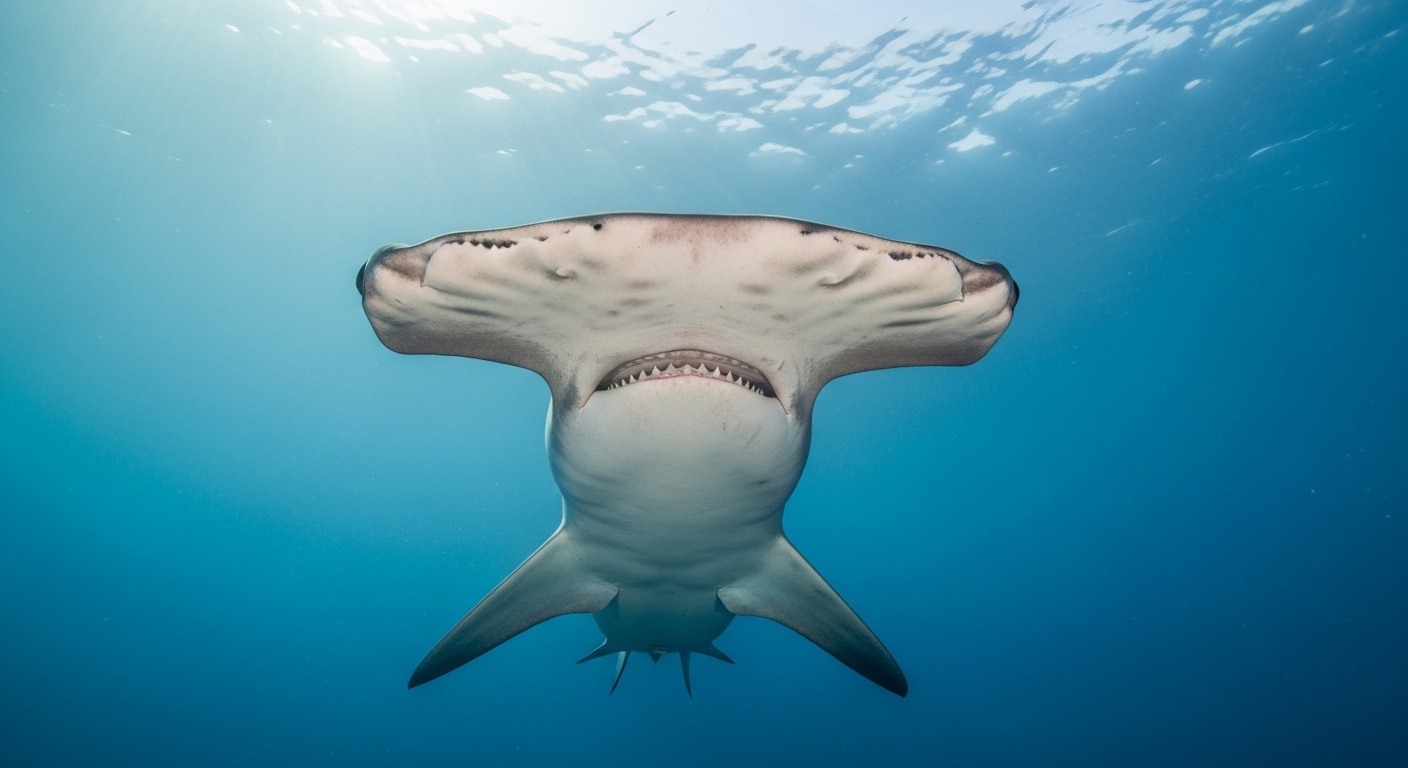
Are Hammerhead Sharks Dangerous to Humans?
For practical purposes, no.
The International Shark Attack File — the global database maintained by the Florida Museum of Natural History — attributes 18 unprovoked bites to sharks of the hammerhead genus Sphyrna, with no fatalities, in its species table current to January 2022. For a group that includes animals approaching six metres long, that is a remarkable record.
A note on that number, because it is worth getting right. Most pages answering this question cite 17 rather than 18 — that figure comes from the ISAF count as of 2018 and has since been superseded. The distinction is small in practice and matters for accuracy: the current primary source says 18, and no fatality has ever been recorded.
One further point of honesty. You will also see claims that a specific hammerhead species was responsible for a particular bite. Those attributions should be treated carefully: the Florida Museum notes that telling hammerhead species apart from a bite is generally not possible, which is why the record is kept at genus level rather than species level.
Put that alongside the sharks that genuinely account for serious incidents, and the gap is stark. Great whites, tiger sharks and bull sharks are responsible for the overwhelming majority of unprovoked attacks worldwide, and between them for almost all fatalities. Hammerheads are not in that conversation.
This does not mean a hammerhead is harmless in the way a goldfish is harmless. A large shark with a full set of serrated teeth can injure a person, and the largest hammerhead species is big enough to be treated with respect. But “capable of causing harm” and “likely to cause harm” are different statements, and the records land firmly on the second.
Asked plainly — is the hammerhead shark dangerous? — the honest answer is that it sits among the safest of the large sharks.
Not One Shark, But Several
Most articles answering this question treat “hammerhead” as a single animal. It is not, and that is where the real answer lives.
The hammerhead family includes about ten recognised species, ranging from sharks barely over a metre long to giants that exceed five. Grouping them together is a bit like grouping a house cat with a tiger because both have whiskers.
| Species | Typical adult size | Risk to humans |
|---|---|---|
| Great hammerhead (Sphyrna mokarran) | Up to ~6 m (20 ft) | The only species treated with real caution — large, bold, occasionally approaches divers |
| Scalloped hammerhead (Sphyrna lewini) | ~3–4 m | Very low — famously shy, schools in large numbers, retreats from divers |
| Smooth hammerhead (Sphyrna zygaena) | ~3–4 m | Very low — few recorded interactions |
| Bonnethead (Sphyrna tiburo) | ~1–1.5 m | Negligible — too small to be a threat; eats crustaceans and molluscs, and uniquely among sharks also digests seagrass |
| Winghead shark (Eusphyra blochii) | Up to ~1.9 m | Negligible |
The bonnethead deserves a footnote of its own. A 2018 study published in Proceedings of the Royal Society B found that it does not merely swallow seagrass incidentally while hunting crabs — it actually digests and assimilates it, making it the only shark known to be genuinely omnivorous. The smallest hammerhead is, in part, a vegetarian.
The species most people picture when they imagine a hammerhead — the enormous one with the wide, straight head cruising a reef — is the great hammerhead. It is also the only one that appears in cautionary advice. The scalloped hammerhead, by far the most commonly encountered, is known among divers for the opposite reason: it is so skittish that photographers struggle to get close before it turns away.
So when you ask whether the hammerhead shark is dangerous, the honest answer depends on which of nine or ten animals you mean.
Have Hammerhead Sharks Ever Killed Anyone?
No confirmed fatality has been attributed to a hammerhead shark in the modern attack records.
That is an unusual sentence to be able to write about a large predatory shark, and it deserves a caveat rather than a victory lap. Attack databases record what is reported and identifiable. In parts of the world with limited reporting, or where a bite goes unwitnessed, attribution to a species is often impossible. The record says no confirmed fatalities; it does not say no hammerhead has ever harmed anyone anywhere.
What the record does establish reliably is the pattern. Across decades of data collection, hammerheads appear in the statistics only occasionally, the incidents are rarely serious, and the great hammerhead — the species with the physical capability to do real damage — is confirmed in vanishingly few cases.
It is also worth understanding how these records are built, because the phrase “shark attack” flattens very different events. Attack files distinguish unprovoked incidents — a shark approaches a person going about normal activity — from provoked ones, where a human action preceded the bite: handling the animal, spearfishing with catch attached, unhooking it, or grabbing it for a photograph. The distinction matters enormously for interpreting hammerhead data, because provoked incidents make up a substantial share of the small total.
Databases also record “bites” rather than “attacks” wherever possible, and the difference is not cosmetic. Most shark bites are single, exploratory, and followed by immediate withdrawal — the animal investigates, decides the object is not food, and leaves. Sustained predatory attacks of the kind that make headlines are a small minority of all incidents, and none of them are attributed to hammerheads.
Put together, the picture that emerges is not a shark that occasionally attacks people. It is a shark that occasionally reacts when handled, and otherwise leaves.
Can Hammerhead Sharks Bite?
Yes. The question is not whether they are physically able but whether they are inclined.
Hammerheads have the same fundamental equipment as other requiem sharks: rows of serrated, triangular teeth designed to grip and cut, replaced continuously through life. A great hammerhead’s jaws are powerful enough to handle large stingrays, including species with venomous barbs.
The point people are usually asking about, though, is intent. Do hammerhead sharks bite humans in practice? The records say it happens, and that it happens rarely — 18 unprovoked incidents across the entire genus and the entire modern record.
Provocation changes the picture, as it does for every shark. A large proportion of shark bites worldwide involve fishing, spearfishing, handling, or an animal that has been cornered. A hammerhead hooked on a line or caught in a net is a frightened, powerful animal, and it will defend itself. That is not aggression toward humans; it is a response to being attacked.
Why Do Hammerhead Sharks Rarely Attack People?
Two things explain the record, and both are more interesting than “they are just shy.”
The head is a sensory instrument. The flattened extension known as the cephalofoil spreads the shark’s sensory organs across a far wider span than a conventional snout. The electroreceptors — the pores that detect the faint electrical fields given off by living tissue — run along its full width. Research comparing hammerheads with pointed-nose sharks found that this does not make the individual receptors more sensitive; what it does is sweep a much wider search area with each pass, like using a wide-beam torch instead of a narrow one. For a shark hunting rays buried under sand, that is exactly the right trade.
The eyes tell a similar story. A study measuring binocular overlap found roughly 32 degrees in the scalloped hammerhead and 48 degrees in the winghead shark, against 10 to 11 degrees in sharks with conventional heads — a substantial gain in depth perception and forward field of view.
There is a plausible safety implication here, and it is worth labelling as interpretation rather than finding. Many serious shark bites are attributed to mistaken identity: an animal in murky water, with limited time to assess a shape, commits and only then discovers that a surfboard is not a seal. That hypothesis is best established for the great white. A hammerhead approaching with a wider sensory sweep and better forward vision may be less prone to that error — but no study has tested the link directly, and it should be read as a reasonable inference rather than a demonstrated fact.
The diet does not include us. Hammerheads are specialists, and their preferred prey is stingrays, along with other rays, bony fish, squid and crustaceans. The great hammerhead in particular is known for hunting stingrays, using its head to pin them against the seabed. A shark built around flat, bottom-dwelling prey has little reason to investigate a swimmer.
Contrast this with the great white, whose adult diet centres on seals and sea lions — animals roughly the size and silhouette of a person on a surfboard. The overlap in appearance is the problem, and hammerheads simply do not have it.
What About the Great Hammerhead?
The great hammerhead is the species that earns caution, and it is worth being clear about why.
Size is the first reason. A mature great hammerhead can exceed five metres and weigh several hundred kilograms, which makes it one of the largest predatory sharks in the ocean. Any animal at that scale demands respect regardless of temperament.
Behaviour is the second. Unlike the scalloped hammerhead, which tends to retreat, great hammerheads are described by divers as bold and curious. They will approach, circle, and hold their distance rather than fleeing. For an experienced diver this is a spectacular encounter; for a swimmer with no context it would be alarming.
What great hammerheads do not do, on the evidence available, is attack people. Their reputation is built on size and presence rather than on a record of incidents. The species is a fixture of shark-diving destinations precisely because encounters are reliable and, handled properly, safe.
So: are hammerhead sharks aggressive towards humans? The great hammerhead is confident and will not necessarily leave when you appear. That is not the same as aggression, and the distinction is worth holding onto.
Where You Might Actually Encounter One
Risk is not just about temperament. It is also about whether your paths cross at all, and for most people they do not.
Hammerheads are warm-water sharks, distributed through tropical and warm-temperate seas worldwide. Within that range, the species separate by habit. Great hammerheads patrol reefs, drop-offs and shallow flats, and are the species most likely to be met by a diver working a reef edge. Scalloped hammerheads spend much of their time in deeper water and around offshore seamounts, coming shallower mainly at night to feed. Bonnetheads, the small ones, are inshore animals of bays and estuaries — and are far too small to concern anyone.
That distribution explains an important asymmetry. Divers meet hammerheads; swimmers almost never do. The encounters that fill photographs and documentaries happen at depth, at remote seamounts, or on deliberate shark dives — not at the beach. If your ocean time is spent swimming from a shoreline in temperate water, your realistic chance of meeting any hammerhead is close to zero.
Juveniles complicate the picture slightly. Several hammerhead species use shallow coastal bays as nursery grounds, so young animals can turn up in surprisingly shallow water. A juvenile hammerhead is a small shark with no interest in anything human-sized, but it does mean that “hammerheads stay offshore” is a generalisation rather than a rule.
Seasonality matters too. In several regions, hammerhead presence peaks in specific months as the animals follow prey and water temperature — which is exactly why shark-diving operators run their hammerhead trips in defined windows rather than year-round.
The Schools That Draw Divers Worldwide
One hammerhead behaviour deserves its own explanation, because it looks far more threatening than it is.
Scalloped hammerheads form schools, sometimes numbering in the hundreds, that circle slowly around seamounts and offshore pinnacles. Sites like Cocos Island off Costa Rica, Darwin and Wolf in the Galápagos, and Malpelo off Colombia have built entire dive industries around the phenomenon. Divers descend into a wall of large sharks moving in formation overhead.
To an outsider it sounds like the setup for a disaster. In practice it is the opposite. These schools are made up of the shyest hammerhead species, and their reaction to divers is to move away. Photographers routinely complain that the schools break apart at the sound of exhaled bubbles, which is why serious shark photographers often dive rebreathers — closed-circuit systems that release no bubbles — specifically to get close enough for a shot.
Why the sharks school at all is not fully settled. Proposed explanations include mating behaviour, navigation using the magnetic features of seamounts, and social structure within the group. What is clear is that the schools are not hunting formations, and they are not aggregating for anything to do with people.
The takeaway for a safety question is counterintuitive but worth stating: the situation where you are most outnumbered by hammerheads is also the situation where they are most likely to leave.
Are Hammerhead Sharks Friendly?
“Friendly” is the wrong frame, but the underlying question is fair.
Sharks are not social toward humans in the way a dog is. They are not seeking interaction, they do not form attachments, and treating a wild predator as friendly is how people get hurt. What can be said is that hammerheads are, as a group, non-confrontational. Divers who spend time with scalloped hammerheads describe them as nervous — a school will scatter at the sound of exhaled bubbles, which is why photographers often use rebreathers to get close.
That skittishness is the real answer. Are hammerhead sharks aggressive to humans? Overwhelmingly, no. Most species actively avoid us, and the one that does not avoid us has still not built a record of harming us.
Is It Safe to Swim With Hammerhead Sharks?
Organised hammerhead diving is a well-established activity in places like Bimini, the Galápagos, Cocos Island and Malpelo, and it operates on the assumption that these encounters are manageable. Thousands of divers do it every year.
That said, “statistically safe” and “risk-free” are not the same. Diving with any large shark carries risk, and the sensible position is the one dive operators themselves take: encounters are safe when the animal is respected and the rules are followed, and they become risky when they are not.
Swimmers, as opposed to divers, will very rarely encounter a hammerhead at all. Most species prefer deeper or offshore water, and the schooling behaviour that makes scalloped hammerheads famous happens well away from swimming beaches.
How to Stay Safe Around Hammerhead Sharks
The guidance below applies to sharks generally, and works for hammerheads specifically.
Stay vertical and keep the animal in view. Sharks are ambush-oriented; an animal that knows it has been seen usually loses interest. Facing a shark and tracking it calmly is more effective than turning your back.
Do not flee at speed. Splashing and rapid, erratic movement resemble a distressed animal. A slow, controlled withdrawal while facing the shark is the recommended approach.
Avoid dawn, dusk and murky water. Low visibility raises the chance of a mistaken approach for any shark species.
Stay away from fishing activity. Bait, hooked fish and speared catch attract sharks and change their behaviour. Most serious incidents involve food in the water.
Leave the jewellery behind. Bright metal flashing in sunlight has long been thought to resemble fish scales. If you want the detail on that particular claim, we looked at it separately in does jewelry attract sharks.
Do not touch, corner or chase. Nearly every bite involving a hammerhead in the records has a human action behind it.
How Hammerheads Compare to Genuinely Dangerous Sharks
If hammerheads are not the sharks to worry about, which are?
Three species account for the large majority of unprovoked attacks on humans worldwide, and the same ISAF table that lists 18 hammerhead bites puts them in a different category entirely: 351 unprovoked attacks and 59 fatalities for the great white, 142 and 39 for the tiger shark, and 119 and 26 for the bull shark.
The reasons differ by species. The great white’s diet centres on marine mammals, and it investigates unfamiliar objects with its mouth. The tiger shark is famously indiscriminate about what it will eat. The bull shark is often argued to be the most genuinely dangerous of the three — not because its numbers are highest, but because it tolerates fresh water and swims far up rivers, putting it in contact with people in places nobody expects a shark.
Set 18 bites and zero deaths against 351 and 59, and the hammerhead’s reputation starts to look like a matter of appearance rather than record.
Hammerheads sit far below all three. At the other end of the scale, the sharks usually described as the most harmless — whale sharks, basking sharks, nurse sharks — are filter feeders or slow bottom-dwellers with no interest in large prey at all.
Seen in that spread, the hammerhead is closer to the harmless end than most people assume, and its reputation is carried almost entirely by its appearance.
The hammerhead’s silhouette is unmistakable, which is why it turns up on so much shark merchandise. Browse our hammerhead shark plush if you want the friendlier version.
The Danger Runs the Other Way
There is a reversal worth stating plainly at the end of an article about danger.
Hammerheads are among the shark species most threatened by human activity. Several are listed as endangered or critically endangered, driven by the fin trade and by high mortality when caught accidentally in fishing gear — hammerheads are notably fragile once hooked, and often do not survive release.
Whatever risk a hammerhead poses to a swimmer, it is dwarfed by the risk humans pose to hammerheads. We cover the conservation picture in more depth separately; here it is enough to note the asymmetry.
Sources
- International Shark Attack File (ISAF), Florida Museum of Natural History — “Species Implicated in Attacks”, data current to 25 January 2022.
- Florida Museum of Natural History — species profile, great hammerhead (Sphyrna mokarran).
- McComb, D. M., Tricas, T. C. & Kajiura, S. M. (2009). “Enhanced visual fields in hammerhead sharks.” Journal of Experimental Biology 212(24): 4010–4018.
- Kajiura, S. M. & Holland, K. N. (2002). “Electroreception in juvenile scalloped hammerhead and sandbar sharks.” Journal of Experimental Biology 205(23): 3609–3621.
- Leigh, S. C., Papastamatiou, Y. P. & German, D. P. (2018). “Seagrass digestion by a notorious ‘carnivore’.” Proceedings of the Royal Society B 285(1886): 20181583.
- Chapman, D. D. & Gruber, S. H. (2002). “A further observation of the prey-handling behavior of the great hammerhead shark, Sphyrna mokarran: predation upon the spotted eagle ray, Aetobatus narinari.” Bulletin of Marine Science 70(3): 947–952.
- IUCN Red List — conservation status of hammerhead species (2019 assessments: great hammerhead and scalloped hammerhead both Critically Endangered).